Ancient · Middle East & North Africa · 3000 BCE - 500 CE
How Ancient Egyptians Made Linen from Flax
From a plant stem to a length of cloth: follow the evidence for fiber preparation, yarn making, weaving, and finishing in ancient Egypt.
By Dan Schnau · Last updated
Ancient Egyptian linen began with flax plants. Workers prepared fiber strips, joined and twisted them into yarn, and wove cloth. Surviving preparations distinguish this process from spinning loose flax fibers.1,2
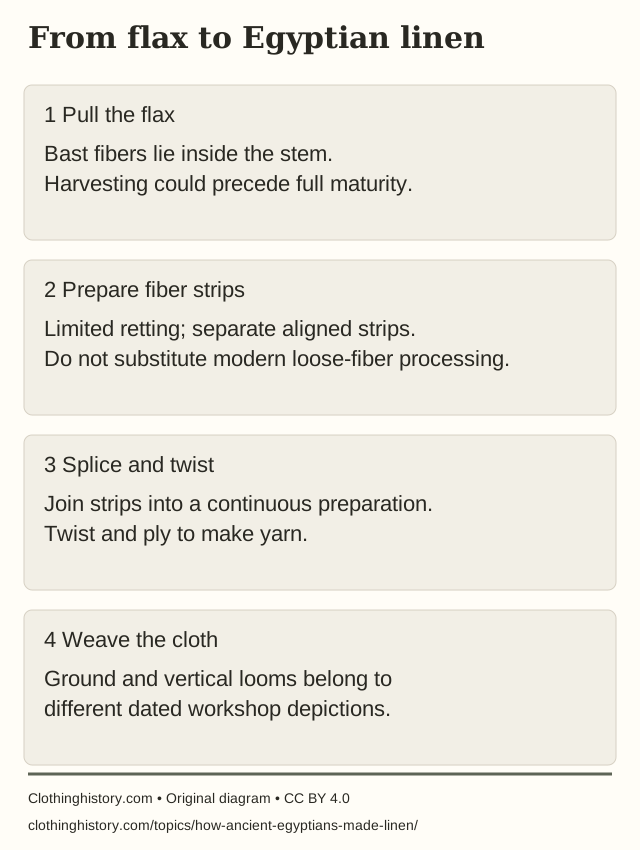
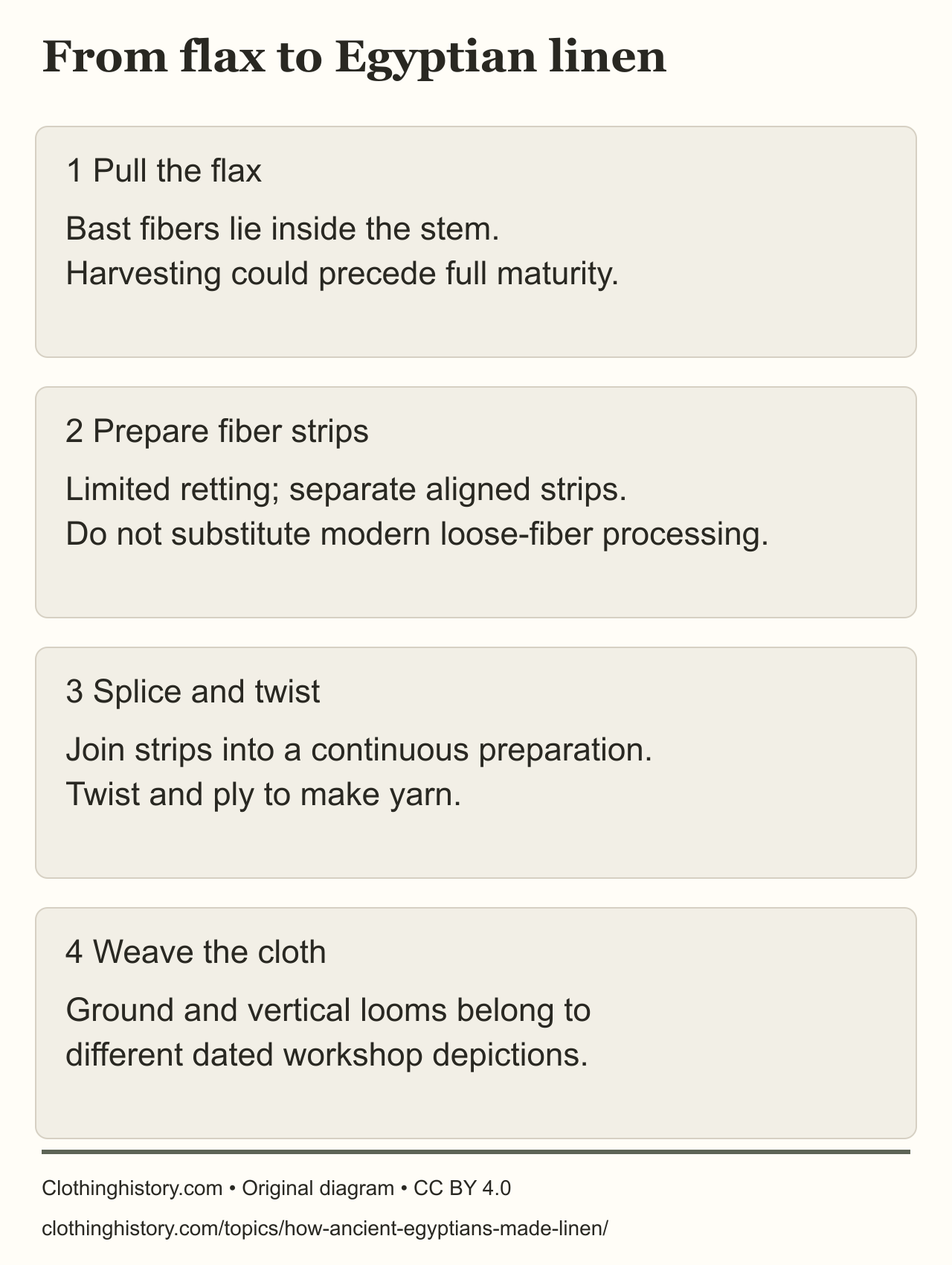
Download the PNG diagram. Suggested credit: “Egyptian linen process, Clothinghistory.com, CC BY 4.0,” with a link to this page.
Growing and pulling flax
Flax needs water, fertile ground, and weeding. Its textile fibers come from the layer between the outer skin and the woody center of the stem. UCL's account describes Egyptian harvesting as pulling plants out of the ground, often before they had fully matured.1
The aim mattered: a crop grown for textile fiber was not left to develop mature seeds in the same way as a seed crop. Seeds, fiber preparations, and depictions therefore answer different questions about what people did with the plant.1
Separating the fibers
Water treatment probably helped loosen the stems, but the UCL account describes only limited retting, the breakdown of material holding the plant cells together. The fibers remained aligned in strips rather than becoming a loose bundle ready for modern-style draft spinning.1
This distinction is worth keeping in mind when watching a modern flax demonstration. It may explain the properties of the plant beautifully while showing a different preparation sequence from the one inferred for dynastic Egypt.
Making yarn by splicing and twisting
Preserved preparations from Lahun show strips joined into a rove, then twisted and plied into yarn. UCL dates the spliced-and-twisted tradition evidenced by textiles to approximately 3500–600 BCE.2
The diagram separates fiber preparation from yarn making deliberately. A stem is not a thread, and a thread is not yet cloth. Looking for the joins in the surviving material gives historians a way to investigate the intermediate stages rather than guessing from the finished garment alone.
Weaving and changing looms
UCL contrasts ground looms in Meketra's workshop model, about 1950 BCE, with vertical looms in Thotnefer's tomb painting, about 1425 BCE.2 These are dated examples, not interchangeable views of one timeless workshop.
Reading the finished cloth
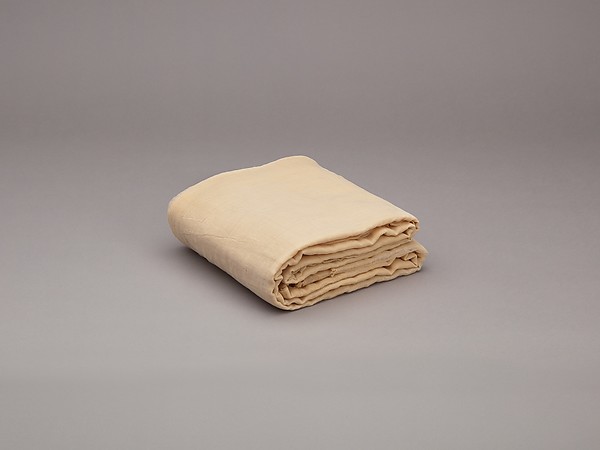
UCL's illustrated examples include plain weave, in which the interlacing follows a one-over, one-under arrangement, and variations on it. Its collection includes a Fayum fragment dated to about 5000 BCE and an Early Dynastic garment from Tarkhan dated to about 3000 BCE.3 These examples show why a textile's structure and its archaeological context both belong in the explanation.
One particularly useful caution concerns linen associated with Thutmose II. UCL notes that it may date to a later reburial rather than the king's lifetime. A royal name attached to a textile does not automatically date its manufacture.3
Color and pleating
Undyed linen has a naturally warm, pale brown tone; washing and exposure to sunlight when wet can make it whiter. Residual plant pectin made new cloth stiffer, helping it hold pleats. UCL also describes pale green linen that may have retained color from immature flax.4
Linen is difficult to dye compared with wool. Most was left without added color, although some Old Kingdom burial textiles carry applied ochre pigments. “Egyptian linen” consequently describes neither one fixed shade nor one uniform quality.4
For the garments made from these materials, continue to ancient Egyptian clothing. For the wider setting, explore ancient Middle Eastern clothing and textiles.
Quick Answers
Was Egyptian linen spun like modern linen?
The evidence here points to spliced fiber strips rather than draft spinning from loose flax.1,2
Did all Egyptian looms stand upright?
No: the depictions include ground and later vertical looms.2
Was all linen white?
No. Natural color, washing, the condition of new cloth, and occasional applied pigments all complicate that picture.4
Sources
- Linen and flax — Hero Granger-Taylor, Digital Egypt for Universities, UCL (plant, harvesting, and fiber preparation).
Return to text (6 references)
Reference 1 Reference 2 Reference 3 Reference 4 Reference 5 Reference 6 - Technology and tools in ancient Egypt — Digital Egypt for Universities, UCL (spliced yarn, preserved preparations, and dated loom depictions).
Return to text (6 references)
Reference 1 Reference 2 Reference 3 Reference 4 Reference 5 Reference 6 - Woven linen — Digital Egypt for Universities, UCL (weaves, archaeological examples, and reburial caveat).
- Natural properties and added colour — Digital Egypt for Universities, UCL (color, pleating, and pigments).
- Length of Very Sheer Linen Cloth — Metropolitan Museum of Art, 36.3.111 (illustrated object, date, and provenance).Reference 1