Bark cloth is a non-woven fabric made by beating the inner bark of a tree into a soft, even sheet. In the Buganda kingdom of southern Uganda, craftsmen of the Ngonge clan have made it from the inner bark of the mutuba tree (Ficus natalensis) for the royal family and the rest of the community.1 It is worn like a toga by both sexes, with women adding a sash at the waist.1
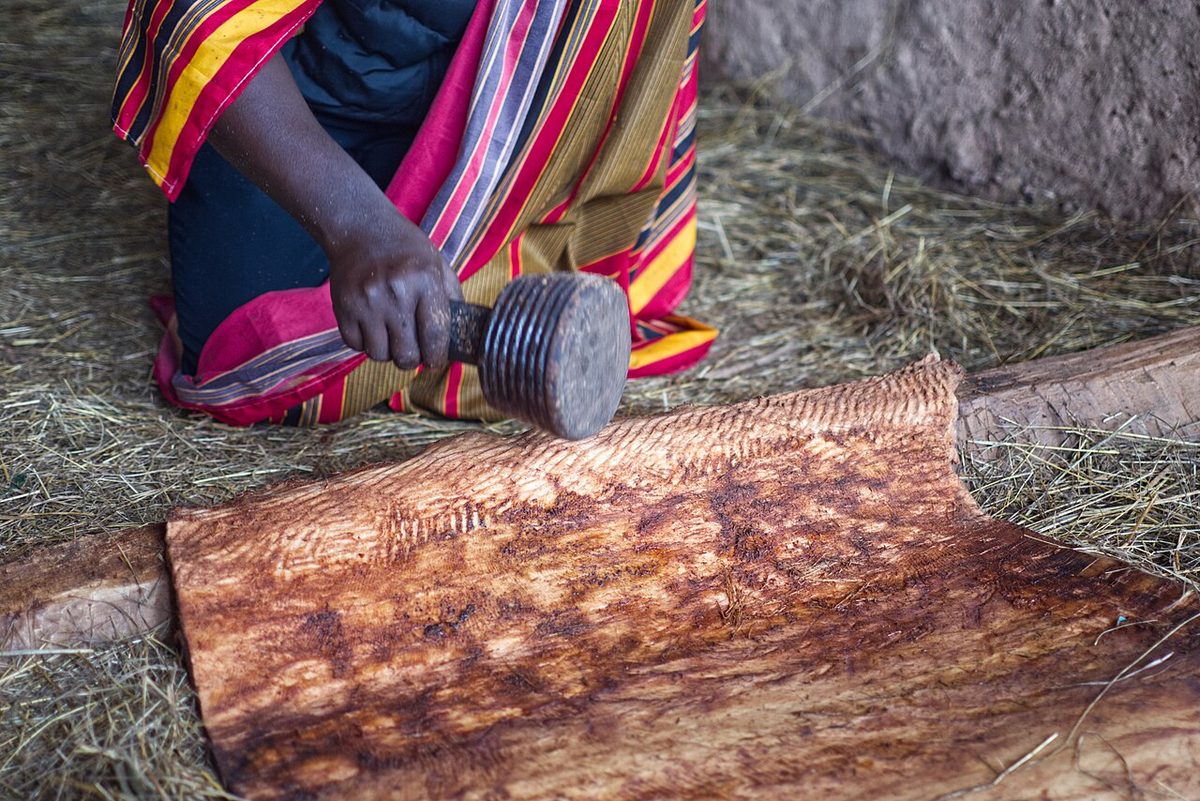
Barkcloth being softened with a grooved wooden beater, Uganda, 2026. Photo: Landsberg-Becher. Wikimedia Commons, CC BY-SA 4.0.

Origins and History
UNESCO describes the preparation of bark cloth as "one of humankind's oldest savoir-faire, a prehistoric technique that predates the invention of weaving." Workshops once operated in almost every village in the Buganda kingdom. After Arab caravan traders introduced cotton cloth in the nineteenth century, production slowed and eventually faded out.1 UNESCO inscribed the craft on its Representative List in 2008.1
Materials and Decoration
The bark is harvested during the wet season and beaten with wooden mallets until it has a soft, fine texture and an even terracotta color.1 Cloths could also be patterned. A bark cloth in Baganda style of the early 1900s in the Cleveland Museum of Art was stamped and painted with natural dyes in concentric circles and four-pointed stars; the museum notes that large examples of this kind served in the Buganda court as prestige dress or as a movable architectural element.2
Meaning and Status
The cloth of kings and chiefs is dyed white or black and worn in a different style to mark their status. Bark cloth is worn mainly at coronation and healing ceremonies, funerals, and cultural gatherings.1
On This Site
- Prehistoric Sub-Saharan African clothing
- Ancient Sub-Saharan African clothing
- Medieval Sub-Saharan African clothing
- Early modern Sub-Saharan African clothing
- 19th century Sub-Saharan African clothing
Sources
- Barkcloth making in Uganda — UNESCO Intangible Cultural Heritage, inscribed 2008 (Ngonge clan, mutuba tree, beating process, toga-like wear, royal colors, ceremonial uses, and nineteenth-century decline; retrieved through the Wayback Machine).
Return to text (6 references)
Reference 1 Reference 2 Reference 3 Reference 4 Reference 5 Reference 6 - Bark Cloth, 1929.368 — Cleveland Museum of Art, open access API (Uganda, Baganda style, early 1900s; stamped and painted pattern; court use as prestige dress).Reference 1