The stambouline (Turkish istanbulin) was the black frock coat that Ottoman men, above all civil officials, wore with the fez after Sultan Mahmud II's dress reform. An album of costume watercolors made around 1840 states that in 1829 Mahmud "issued a decree forbidding the wearing of the old-fashioned costumes, except by clerics," that "The head-dress became the fez," and that men wore "the black frock-coat known as the Stambouline."1
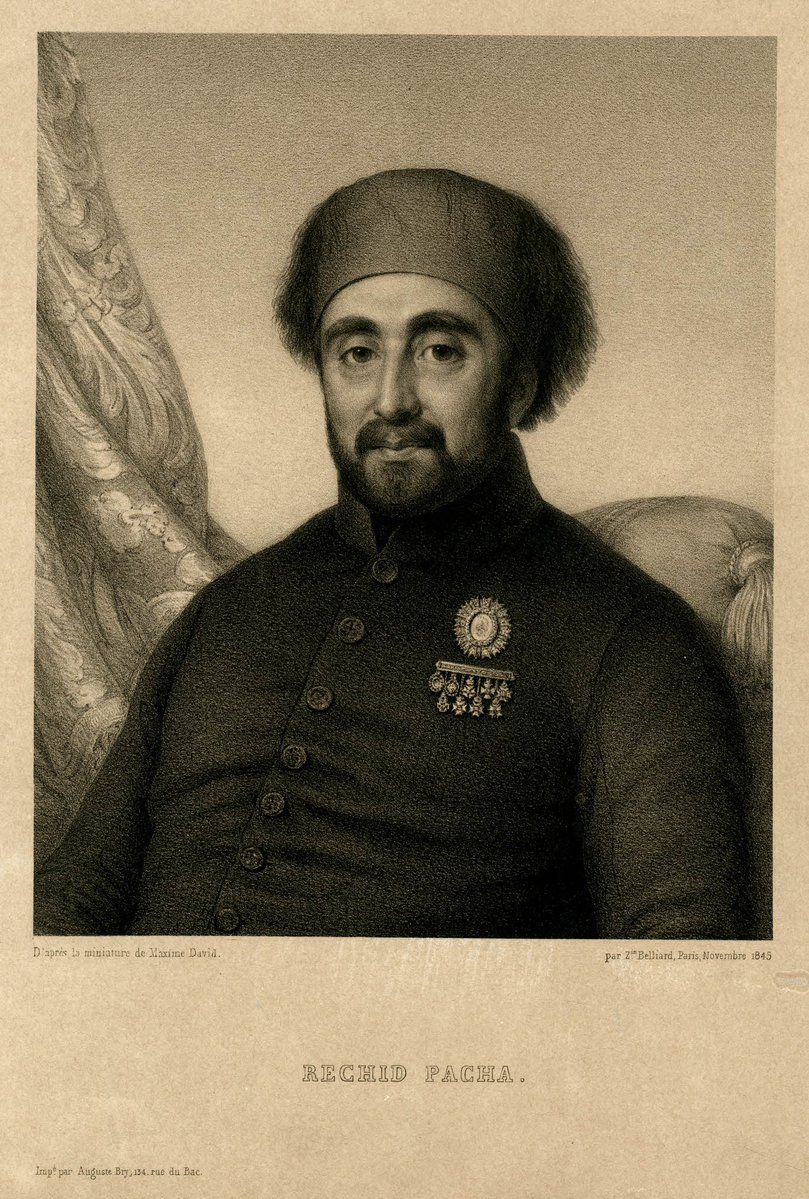
Reşid Pasha, print by Zéphirin Belliard after a miniature by Maxime David, printed by Auguste Bry, Paris, November 1845. SALT Research, Istanbul. Wikimedia Commons, Public Domain.

Origins and History
The Pera Museum in Istanbul, describing a posthumous portrait of Mahmud II, dates the reform to 1828 and shows the sultan in a European-style frock coat, trousers, mantle, and fez.2 A Turkish encyclopedia entry gives a later chronology for the coat itself: the istanbulin was introduced under Sultan Abdülmecid as a formal uniform for civil servants, and after the Tanzimat reforms wearing it became mandatory for civil servants in state offices.3
How It Was Worn
The same entry describes the istanbulin as resembling a redingote, with a stiff straight collar, a closed chest, "a single row of buttons down to the waist," and a length reaching the knees.3 It was worn with the fez, which the Fashion Institute of Technology records was adopted most enthusiastically by the new bureaucratic and professional classes.4
Meaning and Status
The istanbulin became a symbol of status and of Westernization; in Tanzimat and Meşrutiyet novels, characters who wore it were often portrayed as modernists or bureaucrats aligned with state reforms.3 Under Abdülhamid II it lost prominence and was largely replaced by redingote-style jackets.3
On This Site
- 19th century Middle Eastern clothing
- Ottoman clothing, from court kaftans to the fez and stambouline
- Early modern Middle Eastern clothing
Sources
- Watercolor drawings of Ottoman costumes — Qatar National Library Digital Repository, album of 91 drawings, about 1840 (1829 decree, clerics exception, fez, and Stambouline).Reference 1
- Sultan Mahmud II — Athanasios Karantzolas, Pera Museum, Istanbul, via Google Arts & Culture (1828 dress reform, frock coat, trousers, mantle, and fez).Reference 1
- İstanbulin — Mehmet Salih Çoban, Küre Ansiklopedi (cut, introduction under Abdülmecid, Tanzimat requirement, literary image, and replacement under Abdülhamid II).
- The Fez and the Ottoman Path to Modernity — Emerson Hurley, Fashion History Timeline, Fashion Institute of Technology (SUNY), 2023 (adoption of the fez by bureaucratic and professional classes).Reference 1