A keffiyeh is a square headcloth that Arab men fold and wear on the head, held in place by a cord called the agal.2 The traveler John Lewis Burckhardt wrote, in notes published in 1831, that "All the Bedouins wear on the head, instead of the red Turkish cap, a turban, or square kerchief of cotton, or cotton and silk mixed; the turban is called keffie."1 The RISD Museum explains that men generally fold the square into a triangle, with the long edge over the forehead and the points falling at each shoulder and down the back.2
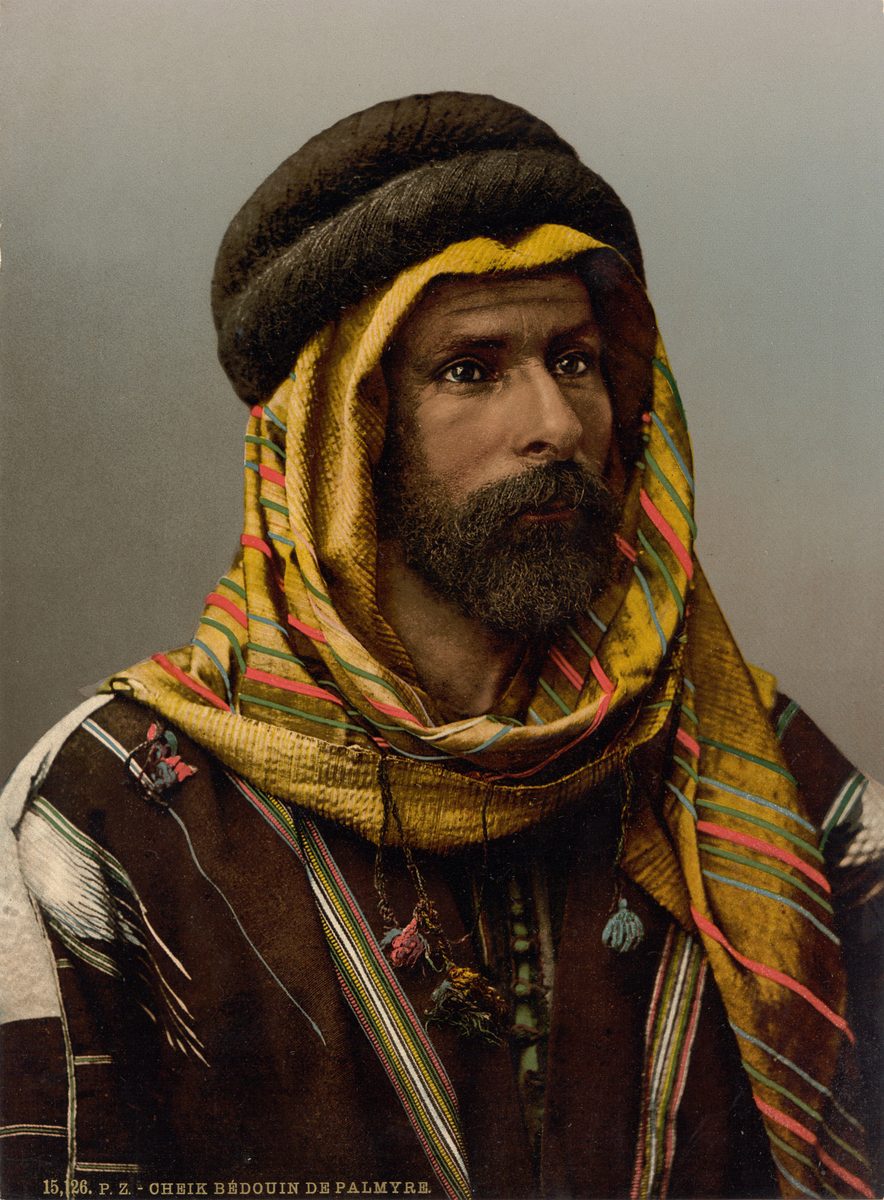
Bedouin sheikh of Palmyra, photochrom after a photograph by Félix Bonfils, 1890s. Library of Congress. Wikimedia Commons, public domain.

How It Was Worn
Burckhardt describes one corner falling backward and two hanging over the shoulders, with which the wearer covered his face against sun, hot wind, or rain.1 The keffie was yellow, or yellow mixed with green, and over it the Aeneze tied a cord of camel's hair.1
Materials and Decoration
A keffiyeh from the Arabian Peninsula dated 1949 in the RISD Museum is plain-weave cotton; the museum records that the checked pattern of the red-and-white keffiyeh "is said to derive from ancient Mesopotamian symbols for wheat or fishing nets."2 Agals were made of goat hair, camel hair, or sheep wool,4 and the RISD Museum's 1949 example wrapped in gold and silk indicates wealth and elite status.3
Origins and History
The RISD Museum states that turbans dominated until the mid-19th century, when the keffiyeh and agal came into widespread popularity, evolving in the 20th century into badges of national identity in many countries of the Middle East.2
On This Site
Sources
- Notes on the Bedouins and Wahábys, vol. 1 — John Lewis Burckhardt, Henry Colburn and Richard Bentley, 1831, "Bedouin Dress," pp. 47–48 (Internet Archive; keffie, folding, colors, and the camel-hair cord).
- Man's head cloth (keffiyeh), 69.138G — RISD Museum, Arabian Peninsula, 1949, gift of the Estate of Theodore Francis Green (materials, folding, checked pattern, and history from mid-19th-century popularity to 20th-century national identity).
- Man's head rope (agal), 69.138F — RISD Museum, Arabian Peninsula, 1949 (gold-and-silk wrapping as a mark of status).Reference 1
- Agal — Sarah Heditsch, Fashion History Timeline, Fashion Institute of Technology (SUNY), 2022, updated 2025 (agal materials cited from the Berg Encyclopedia of World Dress and Fashion).Reference 1