A kanga is a large rectangular cotton cloth, about 150 by 100 centimeters, brightly colored and printed with a distinctive text. Women wear it along the east coast of Africa, especially in Kenya and Tanzania, and in some groups in Oman. Kangas have been part of Swahili dress since the late nineteenth century.2
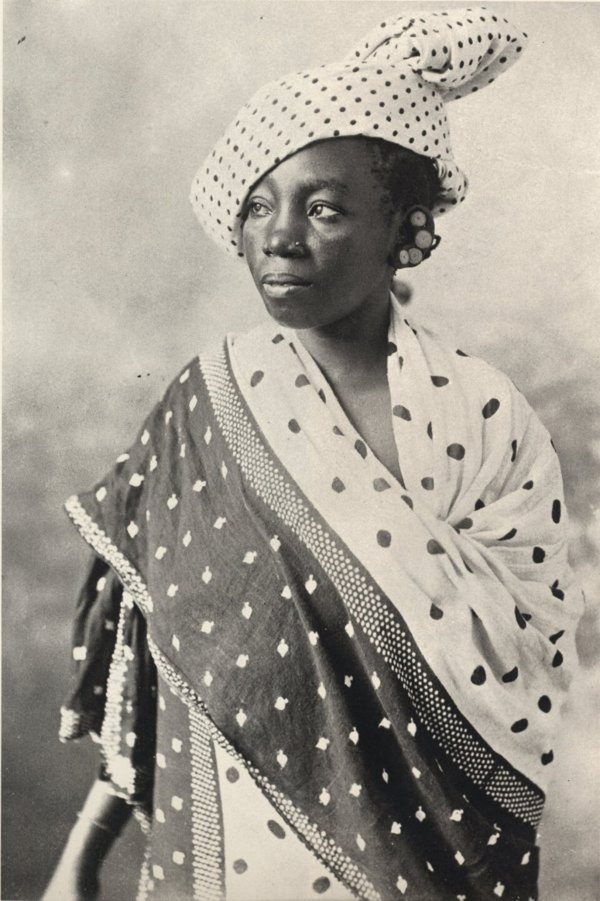
Woman in Zanzibar wearing spotted kanga cloths, photograph by the Coutinho Brothers studio, about 1890. Wikimedia Commons, Public Domain.

Origins and History
According to AramcoWorld, the Portuguese imported a printed Indian calico called leso, which by the nineteenth century developed into a two-piece, block-printed cotton wrap named kanga in Swahili, after the plumage of the guinea fowl of that name. By the 1860s demand had grown all along the coast, from Lamu in Kenya to Madagascar, and in the early 1900s designers began sending designs to India and Europe for mass production.1
Materials and Decoration
A kanga has three parts: the mji, or central design; the pindo, or patterned border; and the jina, a Swahili proverb or saying printed along the edge of the central panel.1,2 Older kangas were hand-printed with wooden blocks, locally or in India, with sayings in Arabic script; recent ones are machine-printed with rollers and use Latin script.2 The Metropolitan Museum of Art catalogs a Tanzanian kanga of 1960 to 1975 as a commemorative wrapper.3
How It Was Worn
Kangas are bought in pairs. One cloth is wrapped around the body at chest height, and the other is draped around the head and shoulders as a modesty veil. Women also use them to carry babies on their backs and wear them daily at home and at weddings and funerals.2
On This Site
- 19th century Sub-Saharan African clothing
- Medieval Sub-Saharan African clothing
- Modern Sub-Saharan African clothing
Sources
- Kanga's Woven Voices — Amanda Leigh Lichtenstein, AramcoWorld, November 2017 (leso and calico origins, the guinea fowl name, 1860s demand, mji, pindo and jina, cutting and hemming pairs; retrieved through the Wayback Machine).
- Kangas from East Africa and India — Textile Travels 4, Textile Research Centre, Leiden (size, wearers, late nineteenth-century dating, block and roller printing, scripts, and ways of wearing).
- Kanga (commemorative wrapper) — The Metropolitan Museum of Art (Tanzania, 1960–1975, cotton and dye; text retrieved through the Met collection API).Reference 1