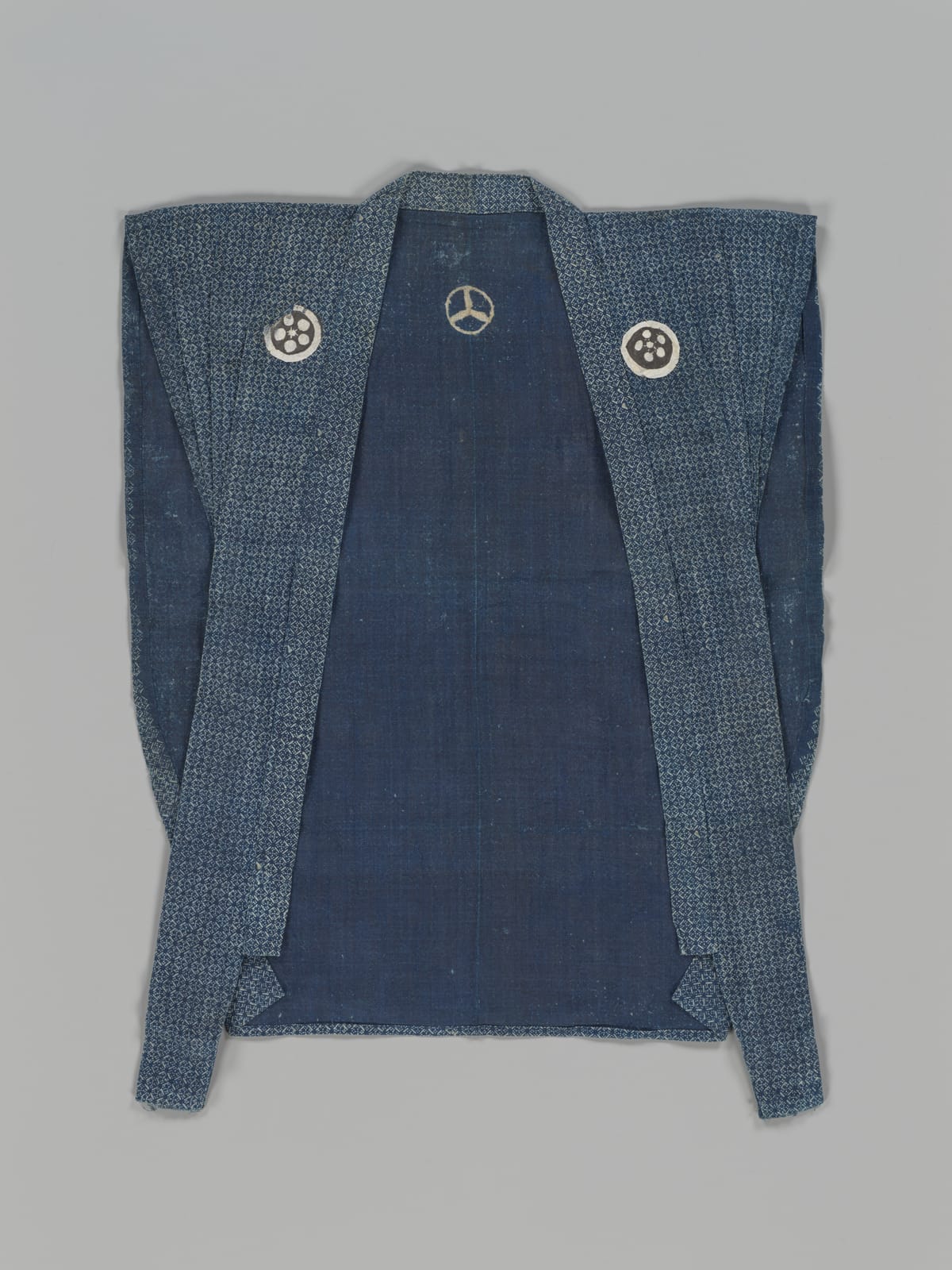
A kamishimo is a two-piece outfit that the Victoria and Albert Museum calls "the everyday formal wear of the Japanese samurai," worn over a kimono on formal occasions during the Edo period.1 The upper garment, the kataginu, is sleeveless with extended shoulders stiffened with paper; the lower garment is the pleated hakama, with narrow ties and a waist board that supports the back.1
How It Was Worn
According to the V&A, the back of the kataginu was tucked loosely into the hakama.1 A V&A woodblock print of 1831 shows the actor Bando Mitsugoro III as an envoy in a formal kamishimo of a wide-shouldered kataginu with long trousers called nagabakama.4
Materials and Decoration
The V&A states that kamishimo are generally made of hemp rather than silk and are patterned using stencils; its example of 1800-1850 has a small all-over design called komon, with the family crest, or mon, of the Aoyama clan on the kataginu and on the back board of the hakama.1 The Metropolitan Museum of Art holds a child's kamishimo of the early nineteenth century in plain-weave bast fiber with stencil-dyeing.2
Meaning and Status
In a watercolor of 1865-1875, the artist Kawanabe Kyosai contrasted an old samurai viewing cherry blossom in full armor with a samurai in kamishimo; the V&A reads the scene as depicting "the anomalous state of the samurai in the late Edo period."3
On This Site
Sources
- Kamishimo, FE.46&A-1980 — Victoria and Albert Museum, 1800-1850 (definition, kataginu and hakama, paper stiffening, hemp, stencils, komon, crests, and how it was worn).
- Child's formal ensemble (kamishimo), 2024.75a, b — The Metropolitan Museum of Art, collection API (early nineteenth-century child's kamishimo, plain-weave bast fiber with stencil-dyeing).Reference 1
- Pictorial Representations of Popular Sayings, D.1375-1897 — Victoria and Albert Museum, Kawanabe Kyosai, 1865-1875 (samurai in kamishimo contrasted with a samurai in armor).Reference 1
- Woodblock print, E.6882-1886 — Victoria and Albert Museum, 1831 (Bando Mitsugoro III as an envoy in kamishimo with kataginu and nagabakama).Reference 1