A jeogori is the jacket-like top of Korean hanbok, worn by women over a chima skirt and by men over baji trousers.1 Jackets of this kind appear in Korean dress of the Three Kingdoms period (57 BC–668 AD), and the Joseon dynasty (1392–1910) produced the version "we are most familiar with today."1
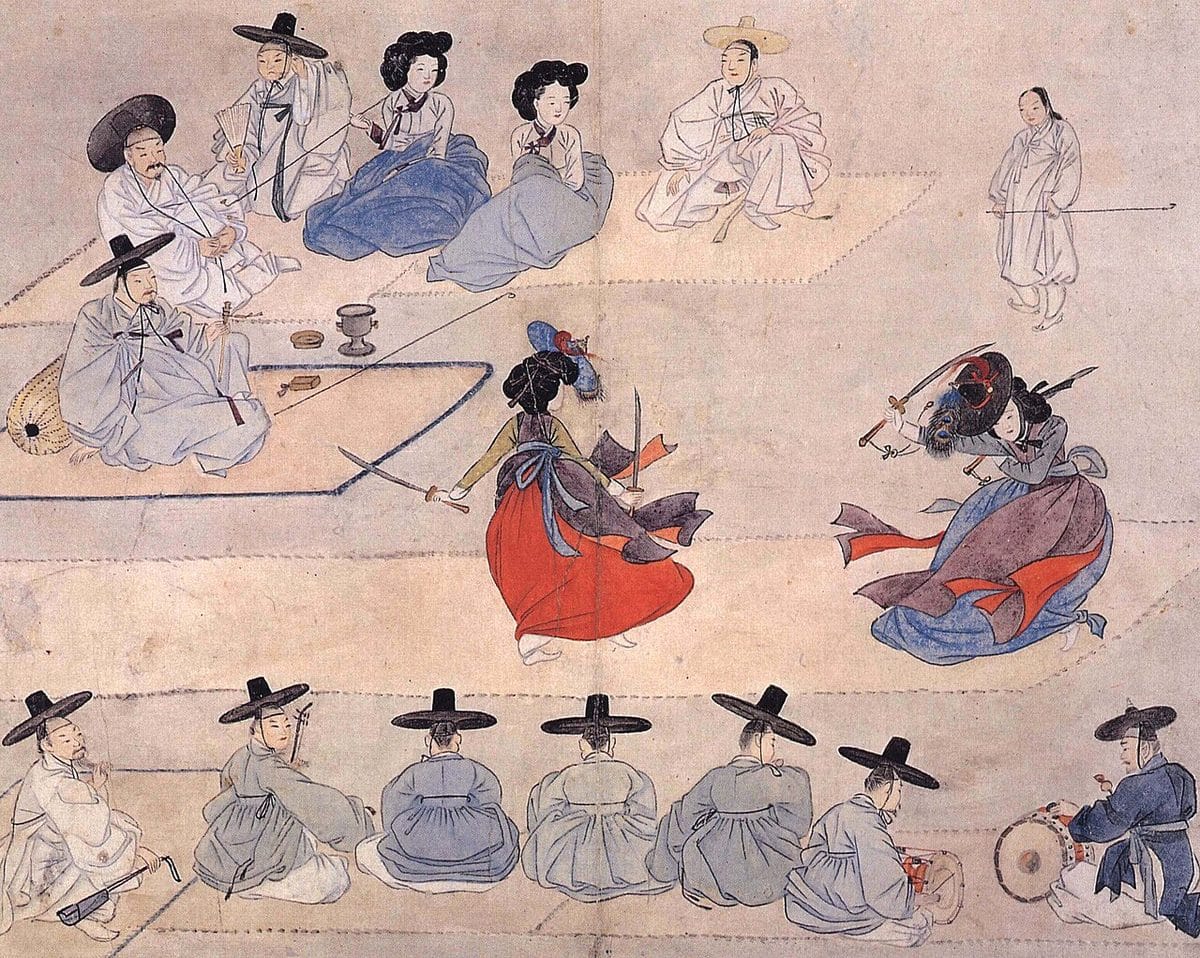
Shin Yun-bok, Sword Dance (Ssanggeom daemu), from the album Hyewon pungsokdo, late Joseon dynasty, ink and color on paper. Kansong Art Museum, Seoul. Wikimedia Commons, Public Domain.

Origins and History
In the Three Kingdoms period the jeogori was "a jacket-like top that wrapped closed at the front."1 During the Joseon dynasty the women's jacket "slowly shortened from 60 centimetres to only 20 centimetres by the early 20th century."1
How It Was Worn
Hanbok is cut and sewn flat, and its tops are "wrapped and tied together with a one-looped bow called a goreum."1 A 1992 jeogori in the Victoria and Albert Museum, made at the Seoul studio of Lee Young Hee, is of figured silk lined with gauze, with a white collar stiffener and a purple silk tie.2
Meaning and Status
Color combinations of jeogori and chima marked specific occasions and the wearer's social or marital status, and women often wore pink jeogori as part of their engagement celebrations.2 A samhoejang jeogori, with colored sleeve ends, armpits, and goreum, was available only to noblewomen; the Victoria and Albert Museum holds a girls' example in yellow and crimson from about 1900–1950.3
On This Site
- Ancient East Asian clothing
- Medieval East Asian clothing
- Early modern East Asian clothing
- 19th century East Asian clothing
Sources
- Hanbok: traditional Korean dress — Jenny Kim, Victoria and Albert Museum, updated 17 April 2024 (top and bottom pieces, Three Kingdoms jacket, shortening, goreum, and flat cutting).
- Jacket (jeogori) — Victoria and Albert Museum, FE.541:1-1992, Lee Young Hee studio, Seoul, 1992 (construction and color combinations by occasion and status).
- Girls' jacket (samhoejang jeogori) — Victoria and Albert Museum, FE.533-2022, Korea, about 1900–1950 (colored sleeves, armpits, and goreum reserved for noblewomen).Reference 1