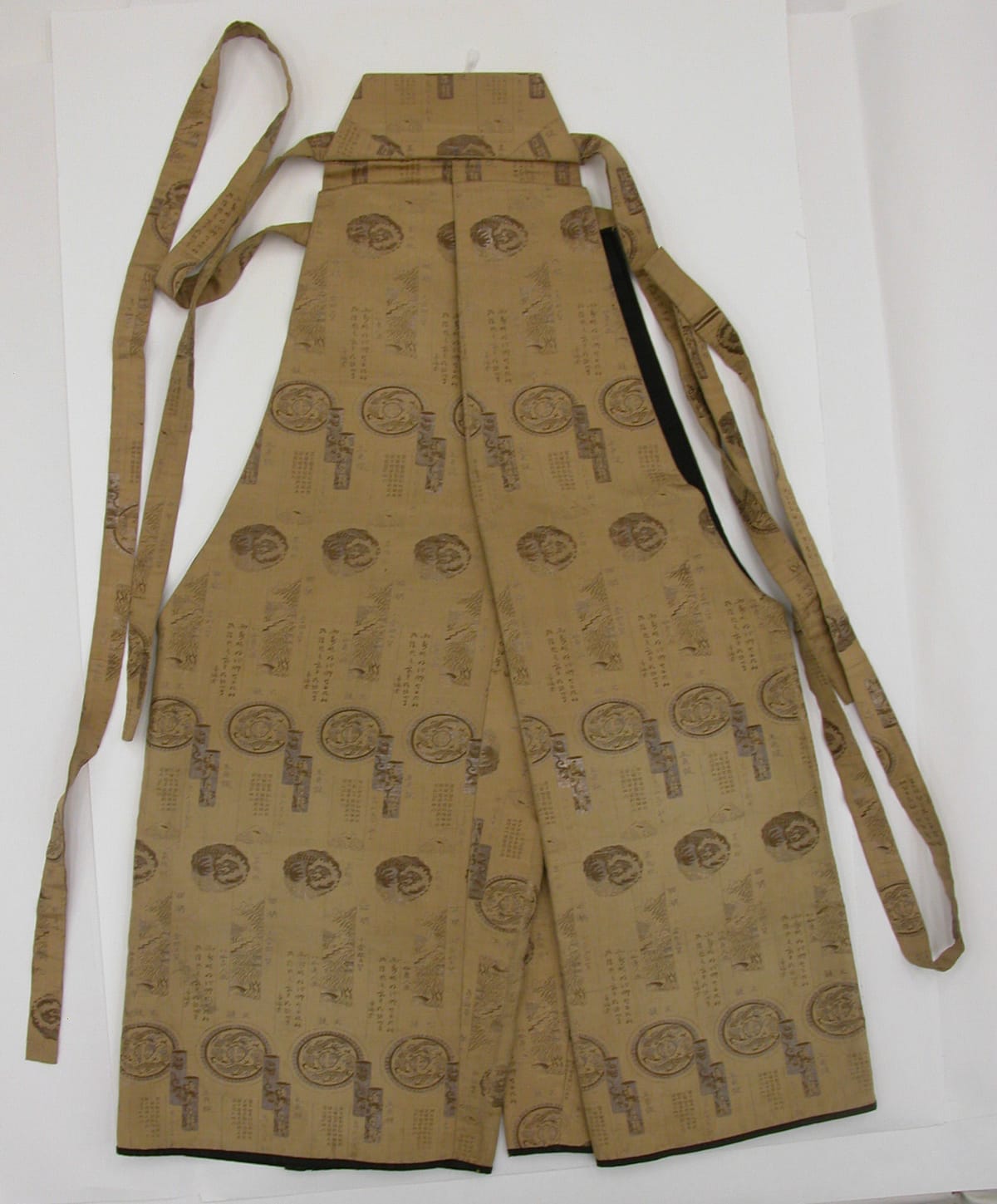
Hakama are a pleated Japanese lower garment, tied around the waist with long bands and described by the Victoria and Albert Museum as "full-cut trousers or a divided skirt."2 They were worn over a kimono by samurai men as part of formal dress in the Edo period,1 by male members of the imperial court,2 and by women students in the Meiji period.4
Origins and History
The Costume Museum in Kyoto, drawing on the Kojiki and the Nihon shoki, reconstructs a man of the era of ancient burial mounds, the Kofun period, in a pipe-sleeved kinu jacket and loose-fit hakama.3 At the imperial court, the V&A states, the formal male costume known as sokutai included two pairs of hakama; its white silk outer hakama of 1800-1880 is slightly pleated at the top, open at the sides, and ties with broad bands.2
How It Was Worn
In the samurai kamishimo ensemble, the V&A explains, the hakama has narrow ties and a waist board designed to support the back; the back panel is stiffened with many layers of paper, and the sleeveless kataginu jacket was loosely tucked into the hakama.1
The Term Today
Masanao Arai describes Meiji-period women students in arrow-feather ikat kimono with maroon pleated hakama, which he calls culotte-like skirts. Around 1878 the students preferred purple, but within ten years maroon became popular, and they were nicknamed "Lady Maroon" (Ebicha Shikibu).4
On This Site
Sources
- Kamishimo, FE.46&A-1980 — Victoria and Albert Museum, 1800-1850 (hakama ties, waist board, paper stiffening, and the tucked-in kataginu).
- Hakama (trousers), T.66-1915 — Victoria and Albert Museum, 1800-1880 (definition, sokutai, outer hakama, pleats, side openings, and bands).
- A Man Wearing Kinu and Hakama — The Costume Museum, Kyoto (Kofun-era kinu and loose-fit hakama from the Kojiki and Nihon shoki).Reference 1
- From Kitsch to Art Moderne: Popular Textiles for Women in the First Half of Twentieth-Century Japan — Masanao Arai, Textile Society of America Symposium Proceedings, 1998 (Meiji women students, maroon hakama, and Lady Maroon).