A fez is a brimless red felt cap that Sultan Mahmud II made the official headwear of the Ottoman Empire, first for his new army in 1826 and then for officials of every rank in 1829.1 The Fashion Institute of Technology (FIT) describes it as "a type of red felt skullcap of Moroccan origin" that "was previously more or less unknown in Istanbul."1
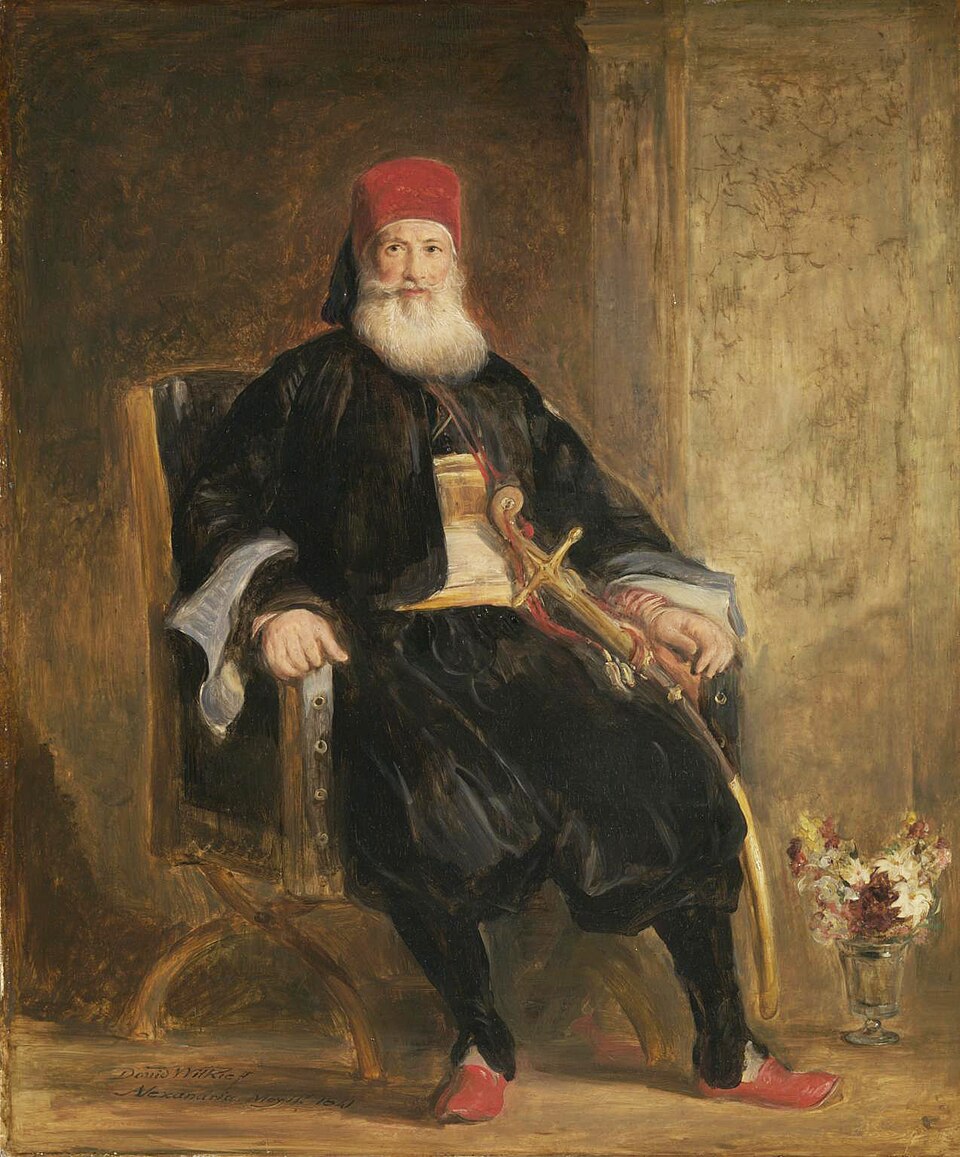
David Wilkie, His Highness Muhemed Ali, Pacha of Egypt, 1841. Tate, London. Wikimedia Commons, public domain.

Origins and History
Mahmud II destroyed the Janissaries in June 1826 and adopted the fez for the force that replaced them.1 His 1829 reform of sumptuary legislation abolished the codes that had dictated the style of turban for each class and ordered officials of every rank to wear the plain fez.1 Sumiyo Okumura records that the sultans themselves started to wear the fez instead of turbans.2 An album of costume watercolors made around 1840 summarizes the decree: the headdress became the fez, and men wore the black frock coat known as the stambouline.3
How It Was Worn
The shape changed with each reign: the somewhat higher mejidiye of Abdülmejid (1839–1861), the squat aziziye of Abdülaziz (1861–1876), and the nearly cylindrical fez favored by Abdülhamid II (1876–1909).1 The new bureaucratic and professional classes adopted it most enthusiastically, while Muslim artisans wore it with a turban-like cloth wrapped around it or rejected it altogether.1
The Term Today
To preserve the fez, Abdülhamid II banned the Western brimmed hat in 1877.1 The Hat Law of November 1925 outlawed the fez in Turkey, and the law remained on the books until 2014.1
On This Site
- 19th century Middle Eastern clothing
- Ottoman clothing, from court kaftans to the fez and stambouline
- Early modern Middle Eastern clothing
- Modern Middle Eastern clothing
- 19th century Sub-Saharan African clothing
Sources
- The Fez and the Ottoman Path to Modernity — Emerson Hurley, Fashion History Timeline, Fashion Institute of Technology (SUNY), 2023 (Moroccan origin, 1826 and 1829 reforms, turban codes, adopters and artisans, mejidiye and aziziye, 1877 hat ban, 1925 Hat Law and 2014).
Return to text (8 references)
Reference 1 Reference 2 Reference 3 Reference 4 Reference 5 Reference 6 Reference 7 Reference 8 - Garments of the Ottoman Sultans — Sumiyo Okumura, Turkish Cultural Foundation (sultans wearing the fez instead of turbans).Reference 1
- Watercolor drawings of Ottoman costumes — Qatar National Library Digital Repository, album of 91 drawings, about 1840 (1829 decree, fez, and stambouline).Reference 1