The stola was a long, sleeveless tunic that Roman women wore over another tunic.1 By the late Republic, every woman married under Roman law was entitled to wear it, although, as Barbara McManus notes, "Not all did, of course."1 Smith's dictionary calls it the characteristic dress of Roman matrons, as the toga was of Roman men.2
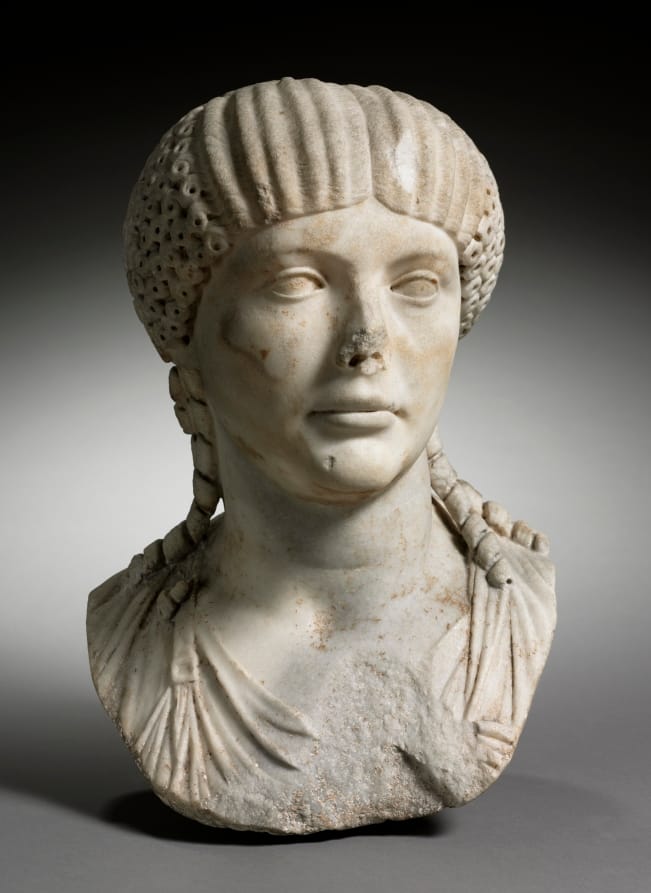
Portrait Bust of the Empress Claudia Octavia, 50–70 CE, marble, 38.2 cm, Cleveland Museum of Art, Purchase from the J. H. Wade Fund, 1925.943. Cleveland Museum of Art, CC0.
How It Was Worn
McManus writes that the stola was "frequently if not always suspended at the shoulders from short straps."1 Smith states that it reached the ankles or feet, was fastened around the body by a girdle, and had a flounce, the instita, sewn to its hem.2 A respectable woman going outside added the palla, a rectangular cloak draped over the left shoulder, under the right arm, and back across the body, which could be pulled up to cover the head.1 The stola was probably made of undyed wool.1
Meaning and Status
The stola marked marital status rather than social class or wealth; McManus calls it "a symbol of marriage" that let a woman display her respectability and adherence to tradition.1 Smith adds that prostitutes were barred from it and wore a dark toga instead, and that women divorced for adultery were also denied the stola.2 The Cleveland Museum of Art describes the bust above, possibly Claudia Octavia, first wife of Nero, as wearing "a stola, a long garment hanging from both shoulders and distinguishing her as a married, upper-class woman."3
On This Site
- Ancient European clothing, including Roman women's dress
- The Roman toga, the male counterpart of the stola
Sources
- Roman Clothing, Part II: Women — Barbara F. McManus, The College of New Rochelle (VRoma Project), 2003 (definition, straps, entitlement, material, meaning, and the palla).
Return to text (6 references)
Reference 1 Reference 2 Reference 3 Reference 4 Reference 5 Reference 6 - Stola — William Smith (ed.), A Dictionary of Greek and Roman Antiquities, John Murray, 1875 (LacusCurtius, University of Chicago) (length, belt, instita, and who was denied the stola).
- Portrait Bust of the Empress Claudia Octavia (1925.943) — Cleveland Museum of Art, collection record via the museum's open access API (the bust illustrated and its description of the stola).Reference 1