The qaba (qabāʾ) is a Persian man's coat or robe, closed at the front or under the arm and worn with a belt or sash over a shirt and trousers, documented from the Seljuq period through Safavid Iran.1,2,3 Elsie Peck writes that at the Seljuq court "Most characteristic for high-ranking men was a stiff, decorated caftan closing diagonally from right to left," a garment that D. S. Rice identified as a qabāʾ.1
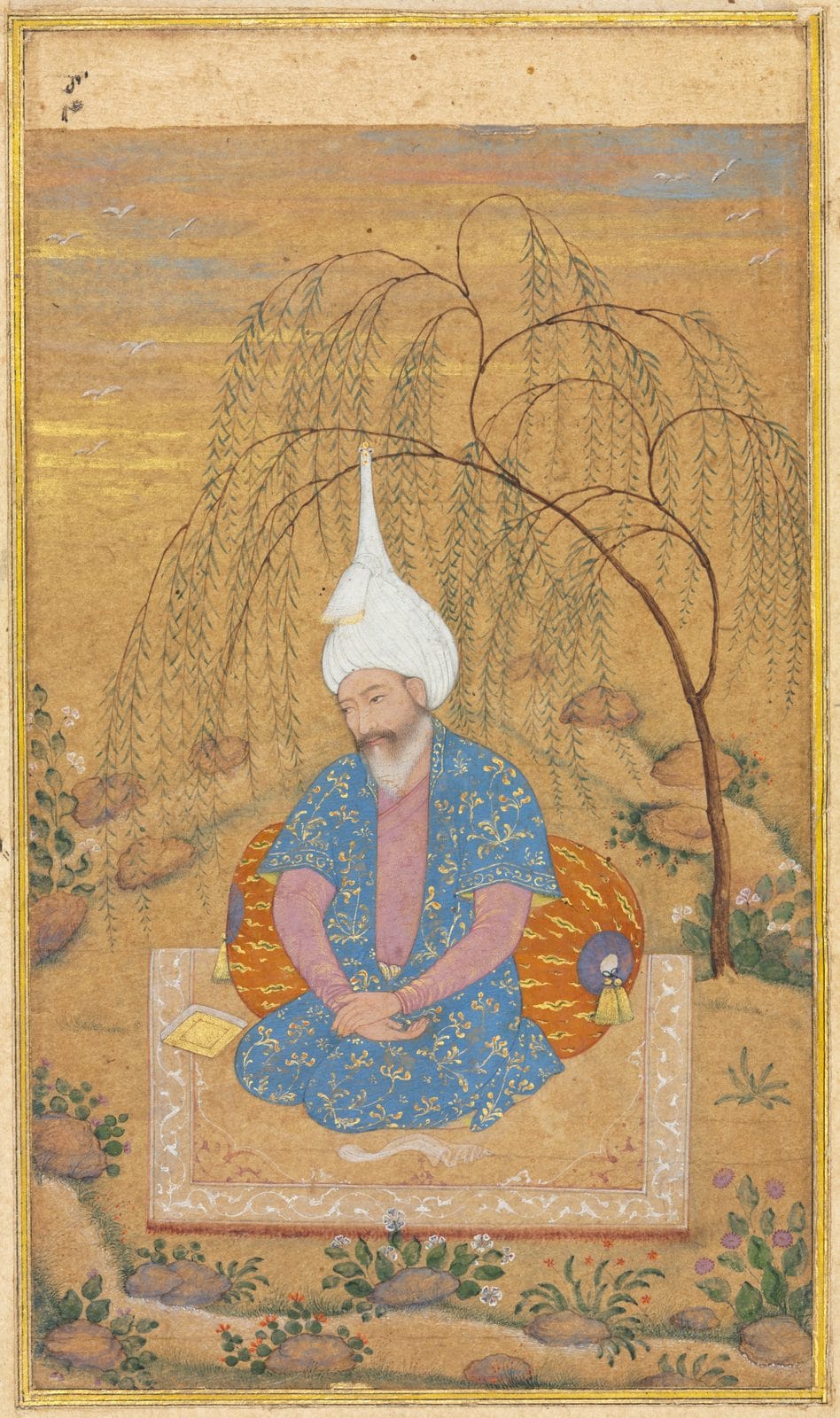
Shah Tahmasp I Seated in a Landscape, opaque watercolor and gold on paper, Qazvin, Iran, about 1575. Cleveland Museum of Art. Cleveland Museum of Art, CC0.
Origins and History
Peck adds that in the Turkish period the version with narrow sleeves and a wide skirt "was the single most important male garment."1 For the Mongol period, Eleanor Sims describes the qabā as "a long sashed or belted coat either wrapped in front and fastened under the right arm or closing in the center, with lapels," worn over a long-sleeved tunic or shirt and trousers tucked into boots or low shoes.2
How It Was Worn
In Safavid Iran the traveler Jean Chardin described a three-quarter-length robe, which he called cabai.3 An early 18th-century writer attributed to the reign of Shah Abbas II (1642–66) the introduction of robes with skirts (qabā-ye dāmandār).3 In 1736 the French traveler Jean Otter noted the similarity of Persian men's costume to that of Europeans and contrasted it with the long, loose robes of the Ottoman Turks.3
Meaning and Status
The qabā belonged to the royal robe of honor. A set of ḵelʿat recorded from the reign of Shah Safi I (1629–42) included outer garments of gold and silver brocade and silk listed as qabā.3
On This Site
Sources
- Clothing viii. In Persia from the Arab conquest to the Mongol invasion — Elsie H. Peck, Encyclopaedia Iranica, 1992, updated 2017 (Seljuq caftan closing right to left, Rice's identification as qabāʾ, and the narrow-sleeved version).
- Clothing ix. In the Mongol and Timurid periods — Eleanor G. Sims, Encyclopaedia Iranica, 1992, updated 2017 (Mongol-period qabā, fastening, and layers).
- Clothing x. In the Safavid and Qajar periods — Layla Diba, Encyclopaedia Iranica, 1992, updated 2018 (Chardin's cabai, qabā-ye dāmandār under Abbas II, Otter in 1736, and the ḵelʿat of Shah Safi I).