Viking clothing is the dress of Scandinavia in the Viking Age, circa 800 to 1050 CE.4 Men usually wore a tunic, trousers, and a cloak. Women wore a strap dress over an undergarment, with the straps fastened at the front by a pair of brooches. Ordinary clothes were made of wool and flax, and the wealthy added silk and gold thread from abroad.1
This page covers the evidence, the clothes, status, and two myths. For the wider European picture, see the early medieval section of medieval European clothing.
How We Know What Vikings Wore
The National Museum of Denmark notes that finds of clothes from the period are rare and often consist of small pieces of material preserved by chance. Written sources, and clothes shown on small figures and tapestries, supplement them.1 Hurstwic warns that the evidence is "limited and spotty," so different scholars examining it come to different conclusions.2
Most surviving cloth comes from graves. Traces of textiles are sometimes found on the underside of jewelry, where the corrosion products of the fabric etched the metal, and from these traces researchers can work out the weave and thread count.2 Worn-out cloth also survives when it was coated with pitch and reused, for example to seal cracks in a ship. According to Hurstwic, at least one complete pair of men's trousers survived this way.2
A few sites carry most of the weight:
- Birka, a trading town on the island of Björkö in Lake Mälaren, Sweden, where Hjalmar Stolpe excavated about 1,100 graves between 1871 and 18956
- Oseberg in Norway, a ship burial where more than one hundred small silk fragments were found7
- Danish graves such as Bryndum, where new dye and fiber analyses have added detail,3 and Hørning, where similar analyses are planned4
Writers from outside Scandinavia add another view. In 922 CE the Arab diplomat Ibn Fadlan met the Rus' on the Volga; Cathy Ostrom Peters describes the Rus' as the eastern Vikings living in Sweden and Russia.1,6 James Montgomery's translation of his account describes their jewelry and a chieftain's funeral clothes, discussed below.5 Icelandic sagas also mention clothing, and Hurstwic draws on them throughout its account.2
Men's Clothing: Tunics, Trousers, and Cloaks
The National Museum of Denmark describes the male outfit as a tunic, trousers, and a cloak. The tunic resembled a long-armed shirt without buttons and might reach the knees.1 Hurstwic calls the wool overtunic the kyrtill and describes it as relatively tight in the upper body, with a skirt from thigh length to knee length. A wealthier man could show off by using more cloth than he needed.2
Hurstwic says tunics of all but the poorest people had woven braid at the neckline and cuffs, made of brightly colored wool in tablet weaving. Silk trim was costly and was probably limited to the wealthiest people.2
Trousers are less well understood. The National Museum of Denmark says that their shape is not well known and suggests a type of plus fours gathered under the knee, worn with socks or puttees, long strips of cloth wound around the legs.1 Hurstwic describes a wide range, from tight to baggy, and notes that poorly preserved trousers with a cut like the tight-fitting Thorsbjerg trousers were found in Viking-era Hedeby.2
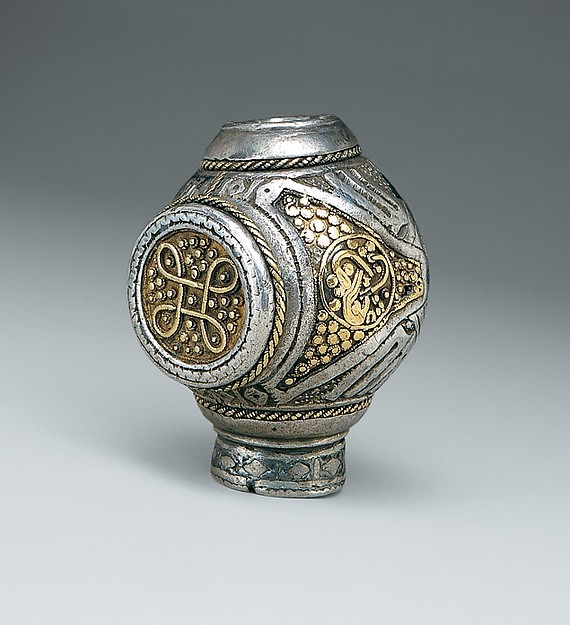
Brooches could themselves be made of precious metals: the Met's ring brooch terminal above, of about 950, is made of silver, gold, and niello.13 Over everything went a cloak. Hurstwic describes it as a large rectangular piece of wool, sometimes lined with wool of a contrasting color.2 It was fastened with a brooch and gathered over the arm a man used to draw his sword or axe, so that, as the National Museum of Denmark puts it, an observer could see whether he was right- or left-handed.1 Ibn Fadlan wrote that the Rus men "do not wear the qurṭaq or the caftan" and that each man wore "a cloak with which he covers one half of his body, leaving one of his arms uncovered."5
Some men also wore pointed or round-crowned caps of cloth or skin.1
Women's Clothing: Strap Dresses and Oval Brooches
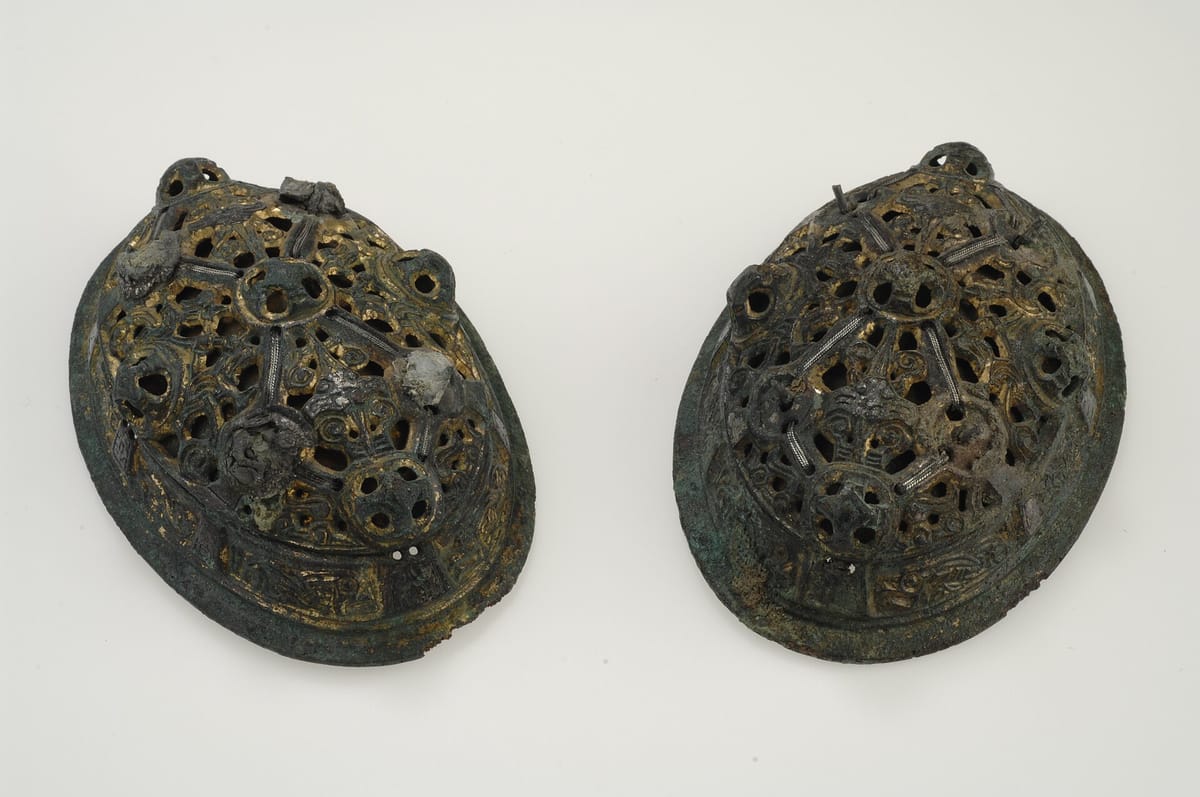

A Viking woman typically wore a strap dress over an undergarment or smock.1 The National Museum of Denmark describes the strap dress as close-fitting, made of coarse material, and either open or sewn together at the sides. Gussets could give it shape. It was held up by two short front straps and two longer back straps, fastened at the front with two large brooches, with strings of beads of amber, silver, bone, or glass often hung between them.1 The Swedish History Museum's record for the Birka brooches above says such brooches held up a wool overdress and fastened strings of beads across the chest.9
These are known as oval brooches; they are also called tortoise brooches, or in modern times turtle brooches, for their shell-like shape.4,9,2
Underneath, Hurstwic describes an ankle-length linen under-dress or shift, its neck closed by a brooch.2 Fashion reached even this layer: Danish women preferred plain undergarments, while Swedish women wore pleated ones, according to the National Museum of Denmark.1 Remains of pleated inner dresses were recorded in about 20 of the 140 female graves at Birka that had oval brooches with preserved textiles.3 On top, women wore a cloak fastened with a small round or three-lobed brooch, along with a belt with small purses and leather shoes.1,2
Ibn Fadlan, by contrast, says almost nothing about women's garments. He describes a small disc of iron, silver, copper, or gold worn on the breast "in relation to her husband's financial and social worth," neck bands of gold and silver, and necklaces of dark-green ceramic beads.5 Montgomery notes that Ibn Fadlan "does not describe how the women dress but concentrates on their accessories."5
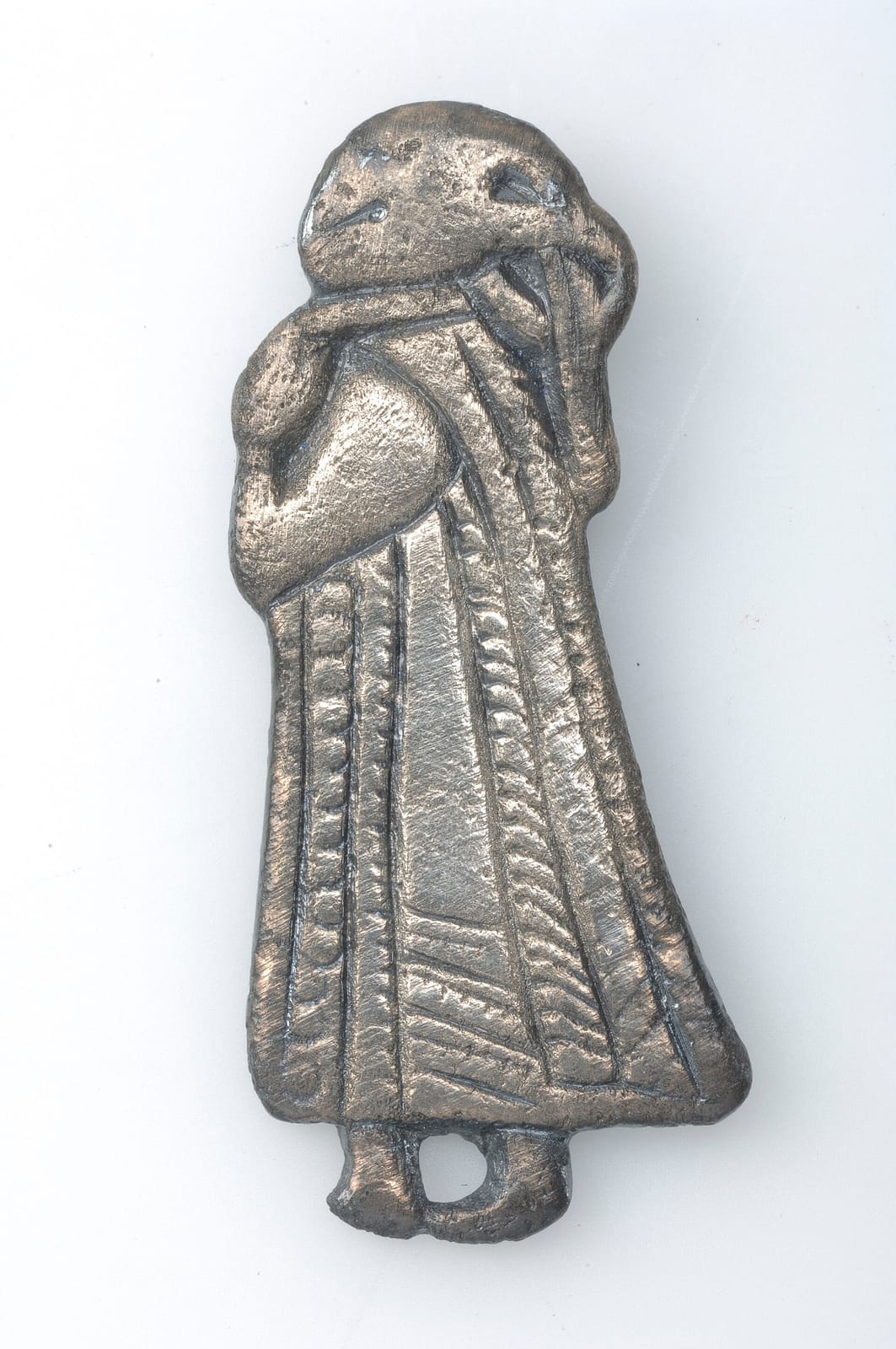

The National Museum of Denmark says pendants show the clothes of the richest women, often with pinafores, trains, and cloaks decorated with bands and border stitching.1 The silver pendant above, from a grave at Birka, is catalogued by the Swedish History Museum as a valkyrie.12
The Apron-Dress Debate and Later Changes
The strap dress is often called an apron dress, and its construction is disputed.4 Hurstwic says some scholars reconstruct the outer dress as two separate panels and others as a slightly flaring tube, longer at the back than the front. Some grave finds have several fabric layers inside the brooches, which has led to the suggestion of an extra apron-like panel hung from the brooches.2 Charlotte Rimstad of the National Museum of Denmark writes that whether the garment was "actually a dress with suspenders or perhaps just a development of the Iron Age peplos dress still remains to be investigated."4
New finds keep adding detail. At Bryndum, on Denmark's west coast, in a cemetery dated to the first part of the ninth century, a buried woman wore a pair of oval bronze brooches. Lab excavation revealed six textiles. She was probably dressed in a blue wool dress with straps made of a tablet-woven wool band, the first time this technique has been recorded for this use. Dye analysis of the dress found an indigotin-containing plant dye, most likely woad. Beneath the dress lay a pleated linen inner garment, which the authors call unusual in a Danish Viking Age context.3
Women's dress also changed over the period. Rimstad notes that oval brooches "suddenly disappear" from Danish graves in the Late Viking Age, so women must have worn a different style. A research project at the National Museum of Denmark is studying what replaced it.4
Wool, Linen, Silk, and Color

Ordinary clothes were made of local wool and flax, woven by women.1 Hurstwic notes that outer garments were long thought to be wool and undergarments linen, but more recent research suggests linen was also commonly used for outer garments.2 The National Museum of Denmark reports that around 40% of finds of Viking Age fabric have been identified as flax. It estimates that more than 20 kg of flax plants and almost 400 hours of work were needed to make one tunic.1
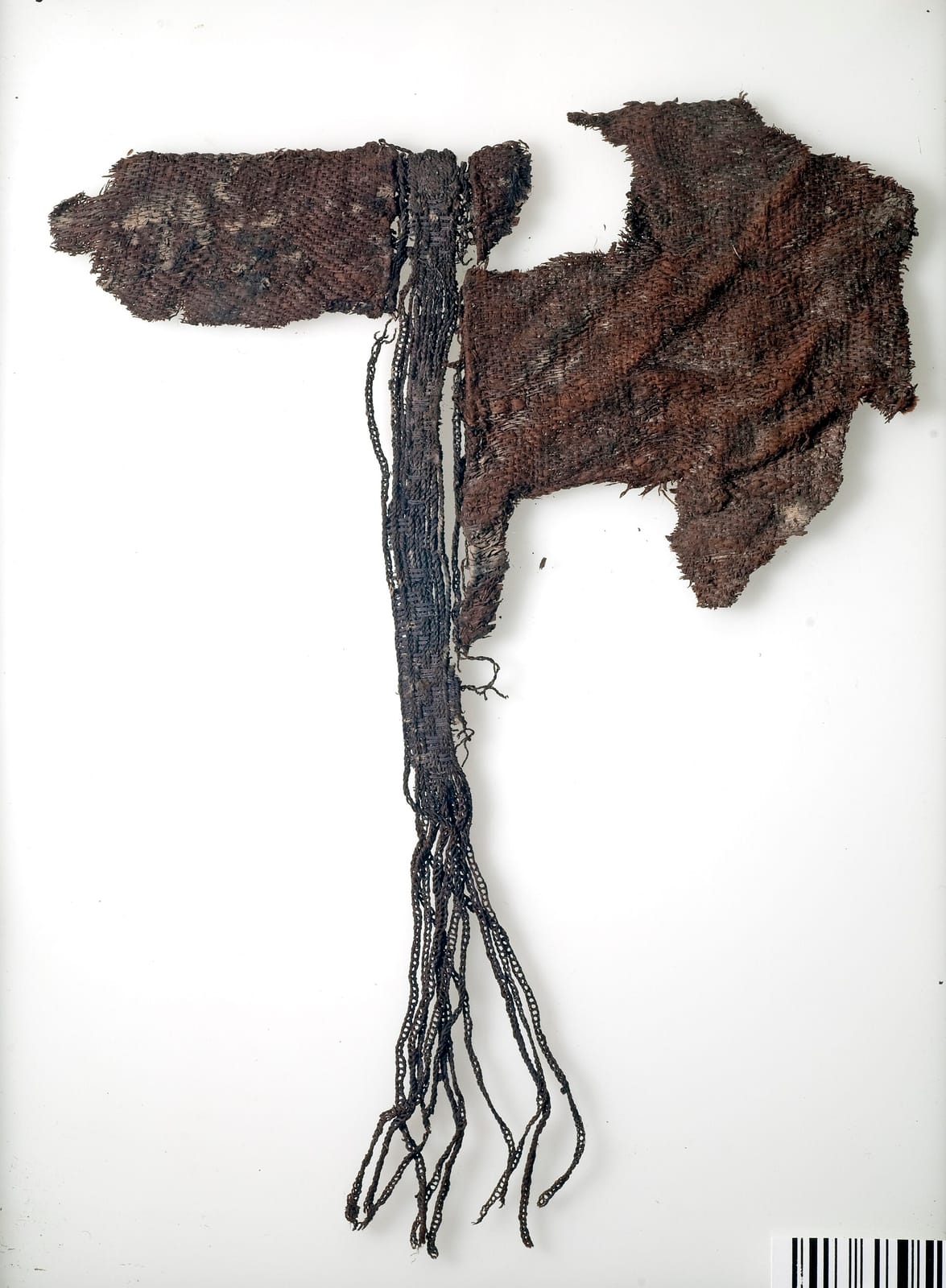
Silk had to be imported. Silk from fifteen different textiles was found at Oseberg, and many pieces had been cut into thin strips for clothing.7 Marianne Vedeler of the Museum of Cultural History, University of Oslo, argues that it is "more logical to assume that most of the silk was purchased in the East, rather than being looted from the British Isles," mainly from Byzantium and Persia. According to the same report, the bulk of the silk imported to Scandinavia was of medium or below-medium quality.7 In Denmark, a ninth-century grave at Fløjstrup held a small blue band of silk samite, the oldest find of silk in Denmark.4 Birka graves also preserve silk fragments, such as the one shown above.11
Dyes produced real color. The National Museum of Denmark lists yellow, red, purple, and blue among the colors archaeologists know from Viking Age clothes. Blue has been found only in burials of wealthy individuals and came from local woad or imported indigo.1 Hurstwic notes that linen undergarments were often left undyed, in part because linen is difficult to dye.2
Status: Silk, Bands, and Fur

According to the National Museum of Denmark, Vikings dressed according to sex, age, and economic status, and the upper classes displayed wealth with silk and gold threads from places such as Byzantium.1 Hurstwic notes that brightly colored clothing was a symbol of wealth and power.2
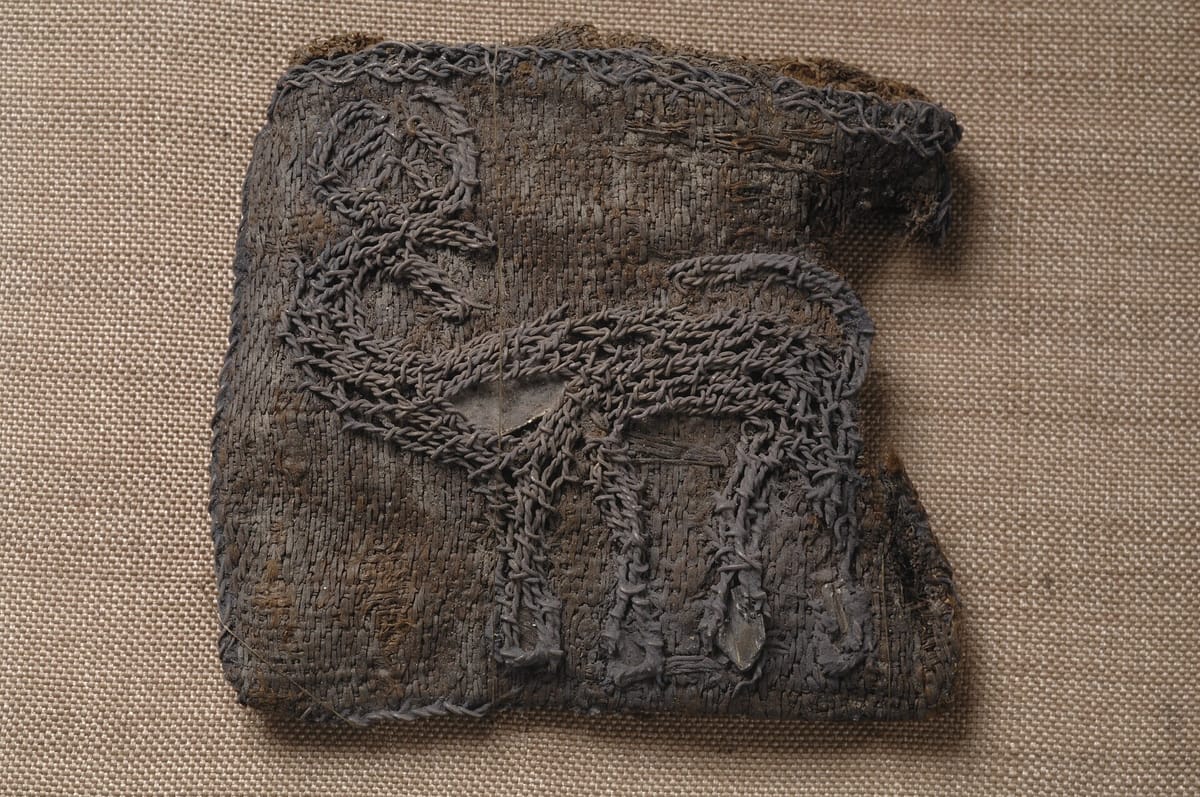
Birka shows this most clearly. Some male graves there held silk textiles, embroideries, trimmings in gold and silver, and tablet-woven bands brocaded with metal thread. Because of these finds, Ostrom Peters writes, "Birka is known as the Silk Road of the North."6 Of nearly 170 graves with textiles, about 60 contained pieces of tablet-woven bands. In grave 735, which held a man and a woman, large sections of band sewn to samite lay across the man's chest.6 The silver-on-silk embroidery of a stag above comes from the same grave.10 Where these bands were made is still debated. Agnes Geijer first thought they were Swedish, then in 1979 decided they were imported, probably by way of Russia from Byzantium.6
Danish elite women wore similar finery. A woman buried around 1000 CE beneath Hørning Church in Jutland wore at least five brocaded tablet-woven bands of silk and silver. The largest was originally about 5 cm wide and 2.5 meters long and ran from her forehead along the shoulders to the legs, as if it had decorated a veil.4 Rimstad points out that neither silk, silver, nor gold is found in Denmark, so these women clearly had international connections.4
Wealthy men wore imported finery too. The man buried at Mammen wore trousers, a knee-length tunic, and a cloak of wool with silk details and gold and silver thread, and his embroidered cloak was lined with marmot fur.1 The National Museum of Denmark describes his red and blue clothes as "those of a magnate."1 Ibn Fadlan watched a Rus chieftain dressed for his funeral in trousers, leggings, boots, a qurṭaq, and "a silk caftan with golden buttons," with a silk cap fringed with sable.5 Montgomery cites Peter Sawyer's comment that the buttons were "not then used in Scandinavian costume," a sign, in Sawyer's view, that these Rus had come to "acquire alien habits of dress."5
Myths Corrected
Horned helmets. "No, helmets from the Viking Age with horns on them have never been found," the NTNU archaeologist Ingrid Ystgaard told sciencenorway.no.8 The horned Viksø helmets found in a Danish bog in 1942 date from the Bronze Age, long before the Vikings. The only preserved Viking Age helmet from Norway, from Gjermundbu, has no horns. The popular image may come from the costumes for the 1876 premiere of Wagner's opera The Ring of the Nibelung, according to Aarhus University's website as cited by the same article.8
Drab, colorless clothes. Brown homespun was only part of the picture. Excavated textiles have revealed yellow, red, purple, and blue, and bright blue and red silks were especially sought after.1 Hurstwic notes that many Norse dyes were bright.2 The Bryndum dress looked entirely black when it was excavated and was probably a deep dark blue.3 Geijer suggested that the Birka silk bands, now a solid brown, were originally woven in silk of several colors.6
Quick Answers
What did Vikings wear?
Men usually wore a tunic, trousers, and a cloak fastened with a brooch. Women wore a strap dress over an undergarment, held up by straps fastened with two brooches, and a cloak on top. Most clothes were wool and linen.1
What did Viking women wear?
A linen shift, a wool strap dress fastened with a pair of oval brooches, and a cloak.1,2 Exactly how the strap dress was constructed is still debated.4
Did Vikings wear bright colors?
Yes. Textiles show yellow, red, purple, and blue. Blue has been found only in wealthy burials, and silk in bright colors signaled status.1
Did Vikings really wear horned helmets?
No. No Viking Age helmet with horns has ever been found. Horned helmets are known in Scandinavia from the Bronze Age, and the popular image may come from nineteenth-century opera costume.8
Sources
- Clothes and jewellery — National Museum of Denmark (evidence, men's and women's dress, Mammen, Byzantine influence, colors, flax).
- Clothing in the Viking Age — Hurstwic (kyrtill, trousers, cloaks, suspended dress interpretations, fibers, dyes, saga references).
- The Bryndum burial ground in Denmark: News on Viking Age women's clothing — Ulla Mannering, Michael Alrø Jensen, Lise Ræder Knudsen, Irene Skals and Ina Vanden Berghe, Archaeological Textiles Review 67, 2025 (ninth-century woman's dress, tablet-woven straps, woad, pleated linen, Birka pleated inner dresses).
- Female dress in the Late Viking Age — Charlotte Rimstad, Archaeological Textiles Review 66, 2024 (Viking Age dates, apron-dress debate, disappearance of oval brooches, Hørning and Fløjstrup graves).
- Ibn Faḍlān and the Rūsiyyah — James E. Montgomery, Journal of Arabic and Islamic Studies 3, 2000 (translation and notes on Rus dress, jewelry, and a chieftain's funeral clothes).
- The Silk Road Textiles at Birka: An Examination of the Tabletwoven Bands — Cathy Ostrom Peters, Textile Society of America Symposium Proceedings, 2002 (Birka excavations, silk and metal-brocaded bands, grave 735, Ibn Fadlan's date, provenance debate).
- Norwegian Vikings purchased silk from Persia — University of Oslo, original by Yngve Vogt, via ScienceDaily, 1 November 2013 (Marianne Vedeler on Oseberg silk, origins, and quality).
- No, the Vikings didn't wear helmets with horns — Bård Amundsen, sciencenorway.no, 19 March 2022 (Viking Age helmets, Viksø helmets, Gjermundbu, Wagner).
- Tortoise brooch, SHM 34000:Bj 1081 — The Swedish History Museum, Stockholm, via Wikimedia Commons (materials and use of oval brooches).
- Embroidery, SHM 34000:Bj 735 — The Swedish History Museum, Stockholm, via Wikimedia Commons (silver-on-silk embroidery from Birka grave 735).
- Textile fragment, SHM 34000:Bj 735 — The Swedish History Museum, Stockholm, via Wikimedia Commons (silk fragment from Birka grave 735).
- Pendant, valkyrie, SHM 34000:Bj 825 — The Swedish History Museum, Stockholm, via Wikimedia Commons (silver female figure pendant from Birka).
- Terminal for an Open Ring Brooch, 2000.140 — The Metropolitan Museum of Art, collection API record (date, medium, credit line).