A kaftan is an outer robe worn over trousers, worn at the Ottoman court by sultans, courtiers, and princes.1,4 Sumiyo Okumura writes that "Kaftan is the general term for a type of outer garment worn over şalvar (trousers)," and that its length "might cover the hips, reach to below the knees, or extend as far as the ankles."1
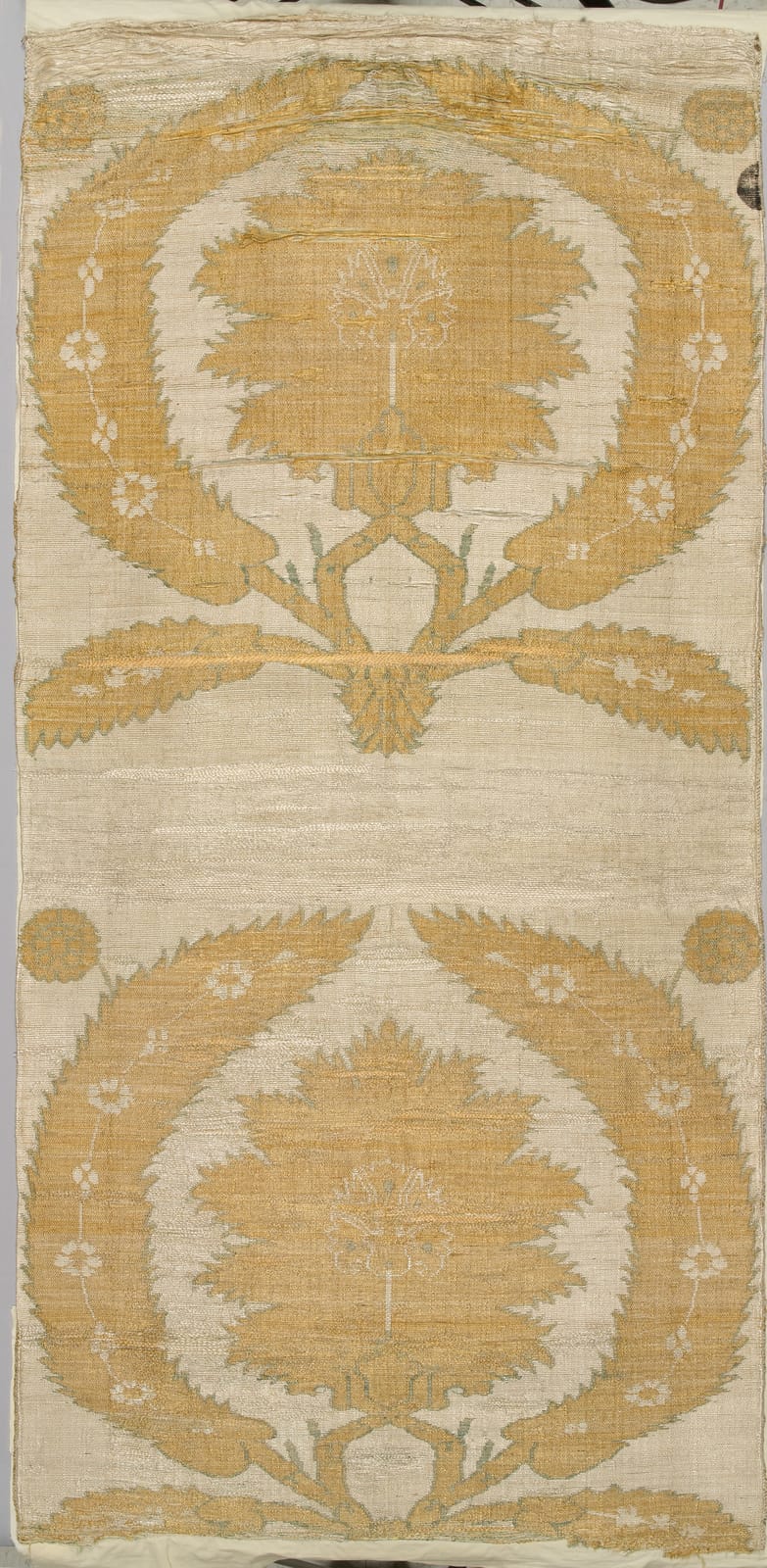
Kaftan, Turkey, second half of the 17th to early 18th century, silk and metal-wrapped thread, taqueté (seraser). The Metropolitan Museum of Art, Purchase, Sakip Sabanci Gift and Rogers Fund, 2003. The Met, CC0.
How It Was Worn
As in other Ottoman garments, the sleeves were sewn to the body without a curved armhole.1 On official occasions a long-sleeved inner robe went on first, and the outermost layer could be the kapaniçe, a sumptuous outer garment.1
Materials and Decoration
Court kaftans were made from heavy silks: kemha (brocade), kadife (velvet), çatma (brocaded velvet), and seraser, "a precious silk fabric woven with threads of gold and silver."1 The Metropolitan Museum of Art holds the front and back pieces of a kaftan of silk and metal-wrapped thread in taqueté (seraser), dated to the second half of the 17th to early 18th century.2 A length cut from a kaftan in the Cleveland Museum of Art, woven in Istanbul in 1525–75 in lampas with silver-metal thread, carries medallions of flowers and leaves, which the museum identifies as signature Ottoman patterns of the second half of the 1500s.3
Meaning and Status
A 16th-century child's kaftan in the Victoria and Albert Museum, silk lampas with gilt-metal thread, belongs to a group preserved in imperial tombs, where, in accordance with Ottoman custom, kaftans were placed over the graves of princes who died in childhood.4
On This Site
- Early modern Middle Eastern clothing
- Ottoman clothing, from court kaftans to the fez and stambouline
- 19th century Middle Eastern clothing
- Modern Middle Eastern clothing
Sources
- Garments of the Ottoman Sultans — Sumiyo Okumura, Turkish Cultural Foundation (definition, lengths, sleeves, inner robe, kapaniçe, and fabrics).
- Kaftan, 2003.416a–e — The Metropolitan Museum of Art, collection API record (date, materials, seraser, and credit line).Reference 1
- Brocaded silk with foliate medallions from a kaftan, 1924.741 — Cleveland Museum of Art, open access API record (Istanbul, 1525–75, lampas with silver-metal thread, and medallion patterns).Reference 1
- Kaftan, 754-1884 — Victoria and Albert Museum, collection API record (16th-century child's kaftan, princes dressed like the sultan and courtiers, silk lampas with gilt-metal thread, and tomb custom).