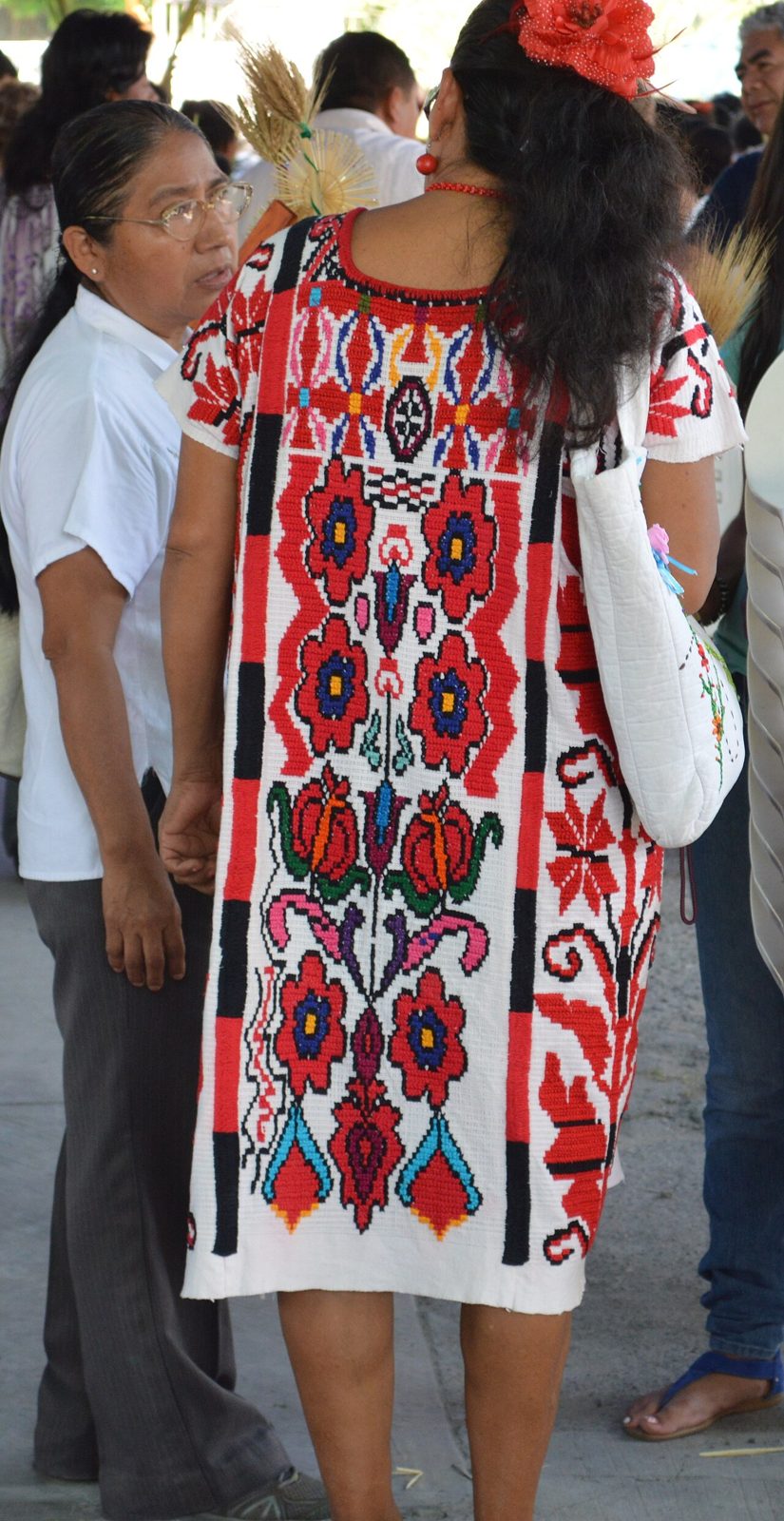
A huipil is a rectangular blouse worn by Indigenous women in Mesoamerica. The Lam Museum of Anthropology states that the word comes from Nahuatl and that the style has been worn by Indigenous Mesoamerican women for over a thousand years.1 The Online Nahuatl Dictionary defines huipilli as an Indigenous woman's rectangular blouse or shift, borrowed into Spanish as huipil, and cites a description of a closed-sewn, sleeveless shift reaching the top of the thighs.3

Origins and History
The Michael C. Carlos Museum describes the Mesoamerican slip-on garment as one with a neck opening and no underarm seam or split, and states that a contemporary Chimaltenango huipil "corresponds to the ancient clothing category of a slip-on blouse."2 An Aztec jade plaque in the Cleveland Museum of Art, dated about 1200 to 1519, shows the water goddess Chalchiutlicue wearing a huipil and skirt.4 The Nahuatl dictionary cites a 1541 list of forty huipils and Florentine Codex descriptions of shifts with feather work and embroidery.3
Materials and Decoration
The Carlos Museum states that Maya cloth was, and is, hand-woven on a backstrap loom.2 The Lam Museum describes a huipil from San Mateo Ixtatán, Guatemala, hand-embroidered on a double layer of commercial white cotton so that it is reversible, a tradition it dates to at least the beginning of the 20th century.1
Meaning and Status
The Lam Museum states that huipiles express the wearer's ethnic identity and often indicate a specific community of origin.1 The Carlos Museum notes that widows wear darker colors and avoid red, while unmarried girls wear more colorful garments.2
On This Site
- Ancient Americas clothing
- Medieval Americas clothing
- Early modern Americas clothing
- Modern American clothing
- Aztec clothing: Mexica dress, textiles, and tribute cloth
Sources
- Maya Huipil — Timothy S. Y. Lam Museum of Anthropology, Wake Forest University, 3 June 2024 (definition, Nahuatl origin of the word, more than a thousand years of use, San Mateo Ixtatán embroidery, and community identity).
- The Ties that Bind: Ancient Maya Textiles and the Modern Tradition — Dorie Reents-Budet, Michael C. Carlos Museum, Emory University (slip-on blouse category, backstrap loom, and color conventions for widows and unmarried girls).
- huipilli — Online Nahuatl Dictionary, Wired Humanities Projects, University of Oregon (definition, Spanish borrowing, Olko's description after Anawalt, and colonial attestations).
- Goddess Plaque, 1949.199 — Cleveland Museum of Art, Aztec, c. 1200–1519 (Chalchiutlicue shown in a huipil and skirt; record retrieved through the Cleveland open access API).Reference 1