A dragon robe, or jifu ("auspicious dress"), is a Chinese silk court robe decorated with dragons, worn by emperors, princes, and officials.1 Dragon robes originated in the Liao dynasty (907–1125), were regulated as court dress under the Ming (1368–1644), and the Qing dynasty (1644–1911) continued this usage.1
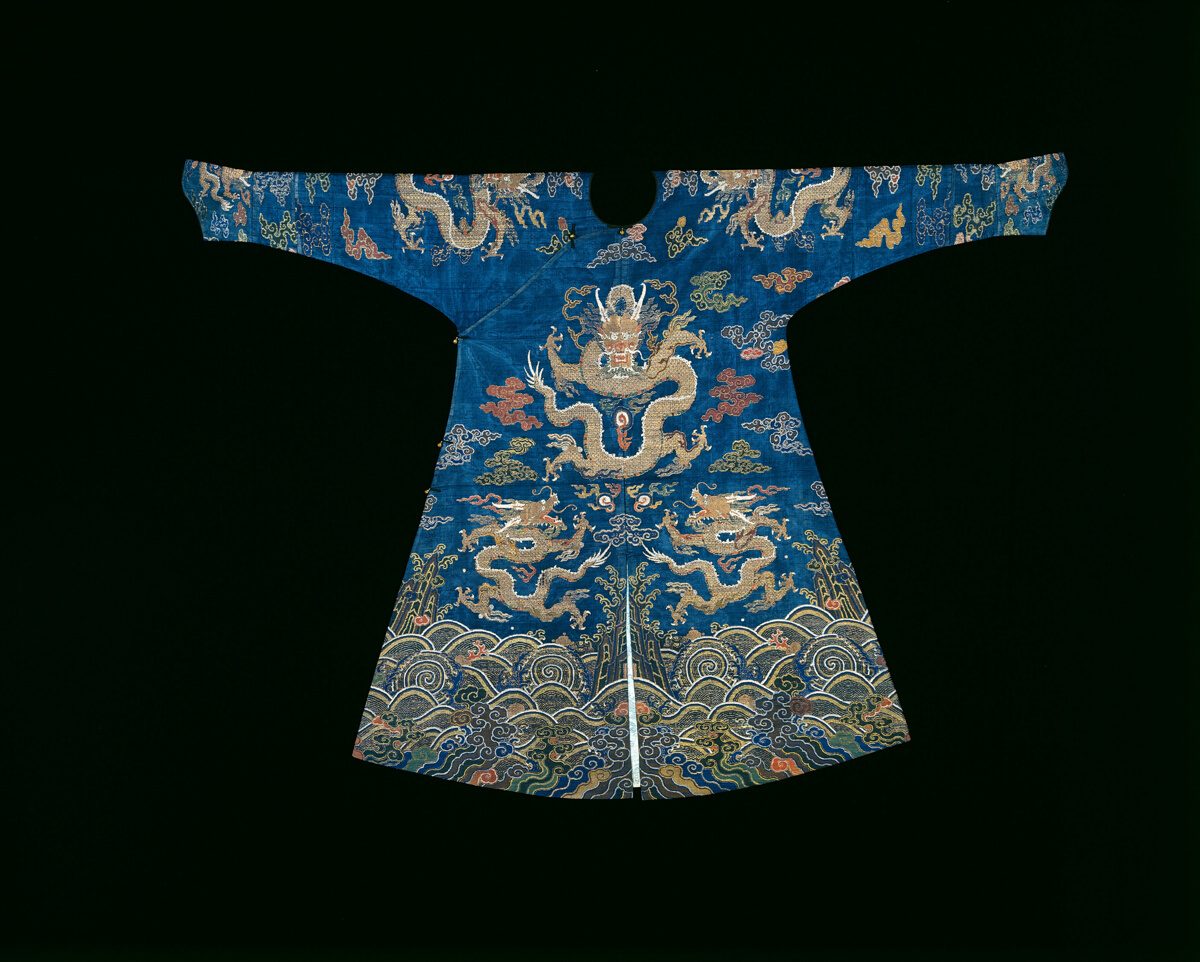
Man's jifu (semiformal court robe), Qing dynasty, 1720/40, silk gauze brocaded with gold-leaf-over-lacquered-paper strips. Art Institute of Chicago, gift of Mrs. William M. Allison. Art Institute of Chicago, CC0.
Materials and Decoration
A late eighteenth-century jifu in the Cleveland Museum of Art is silk satin embroidered with silk and metal thread; its dragons, clouds, waves, and rocks "form a diagram that symbolizes the universe," with the waves at the hem representing the oceans, the rocks the earth, and the dragons above them symbols of imperial authority.2 The Qing standardized a nine-dragon design, with the ninth dragon beneath the robe's overlap.1 A medallion in the Penn Museum, cut from the robe of a Ming imperial family member and dated 1550–1644, shows a five-clawed winged dragon chasing a flaming pearl in silk and gold thread.3
Meaning and Status
Five-clawed dragons were "theoretically restricted to emperors and princes," though they circulated more widely during the late Qing.1 Only the emperor and his consort could wear bright yellow (ming huang) robes, and only the emperor could wear robes with four skirt slits.1 The emperor wore a jifu at semi-official meetings at court but not for official state rituals.2
How It Was Worn
The dragon robe was worn with an ensemble of hat, surcoat, collar, belt, necklace, and boots.1 The brown color and two slits of a robe of 1796–1820 in the Cooper Hewitt suggest that it belonged to an official of the Jiaqing period.1
On This Site
Sources
- Five-Clawed Dragon — Cooper Hewitt, Smithsonian Design Museum, 2017, man's robe 1960-32-1 (jifu, Liao origin, Ming and Qing regulation, nine dragons, claws, yellow, slits, ensemble, and Jiaqing dating).
Return to text (7 references)
Reference 1 Reference 2 Reference 3 Reference 4 Reference 5 Reference 6 Reference 7 - Semi-formal Court Robe (Jifu) — Cleveland Museum of Art, 1983.32, Qing dynasty, Jiaqing period, late 1700s (silk satin and embroidery, cosmological diagram, yellow reserved for the emperor and consorts, and semi-official use).
- Dragon Robe Fragment — Penn Museum, University of Pennsylvania, 52-23-1, Ming dynasty, 1550–1644 (medallion from a Ming imperial family member's robe, five-clawed winged dragon, flaming pearl, silk and gold thread).Reference 1