The doublet was a snug jacket shaped to a man's body, worn in Europe from the fourteenth century until about 1670.1 It was long-sleeved, fastened at the center front, and worn as a padded jacket next to the shirt.1 Susan Torntore writes that it developed in the late thirteenth and early fourteenth centuries as padded wear under plate armor, when early versions were called pourpoint or gipon.2
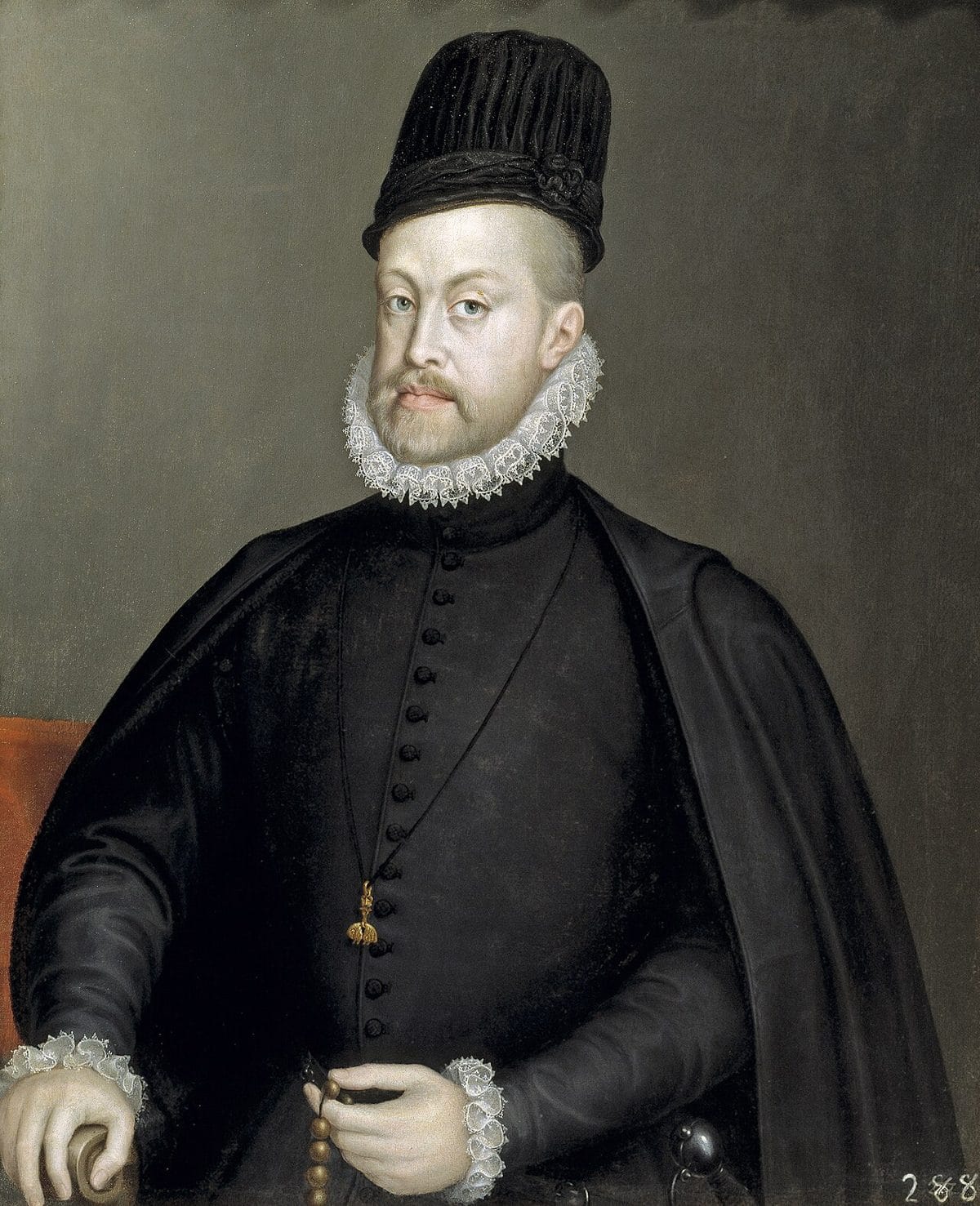
Philip II of Spain dressed in black, by Sofonisba Anguissola, 1565. Museo del Prado, Madrid. Wikimedia Commons, Public Domain.

Origins and History
Torntore connects the French name pourpoint to "for the points," the laces that tied the hose to the doublet.2 In the sixteenth century the doublet was heavily padded, with slashing and panes; stiffened linen canvas and fillings of wool, bran, or horsehair produced the "peascod belly" shape.2 Padding was abandoned in the seventeenth century, and by 1670 the doublet had given way to the waistcoat and coat of the three-piece suit introduced by Charles II of Britain.2
How It Was Worn
A V&A doublet of 1635–40, in bleached and glazed linen embroidered with white thread, has a standing collar, four large tabs below the natural waistline, belly pieces possibly of baleen, twenty-nine linen-covered buttons, and an inside lacing band with thirty eyelets.3 Its back and sleeve seams were left open so the shirt could billow through.3 The V&A also notes that between 1650 and 1665 doublets shortened, leaving a gap between doublet and breeches where the shirt showed.1
On This Site
- Early modern European clothing, from the padded doublet to the justaucorps
- Medieval European clothing and the hose laced to the doublet
Sources
- doublet — Fashion History Timeline, Fashion Institute of Technology, 2018, updated 2025 (definition, dates, fastening, the Berg Dictionary description, and the V&A note on the 1650–1665 shortening).
- Doublet — Susan J. Torntore, in Valerie Steele (ed.), Encyclopedia of Clothing and Fashion, Charles Scribner's Sons, 2005 (Encyclopedia.com) (origins under armor, pourpoint, sixteenth-century padding, and replacement by 1670).
- Doublet, 1635–40 (177-1900) — Victoria and Albert Museum, collection record via the museum's API (construction, materials, buttons, lacing band, and open seams).