The chemise was the linen undergarment worn next to the skin by European women, beneath every other layer of dress. Lourdes Font of the Fashion Institute of Technology calls it "the common foundation of all women's dress" in the early fifteenth century, with the quality of the linen separating one class from another, and "the basic undergarment worn by all classes" in the 1430s.1,2 The Victoria and Albert Museum notes that the name comes from the French word for shirt or shift.3
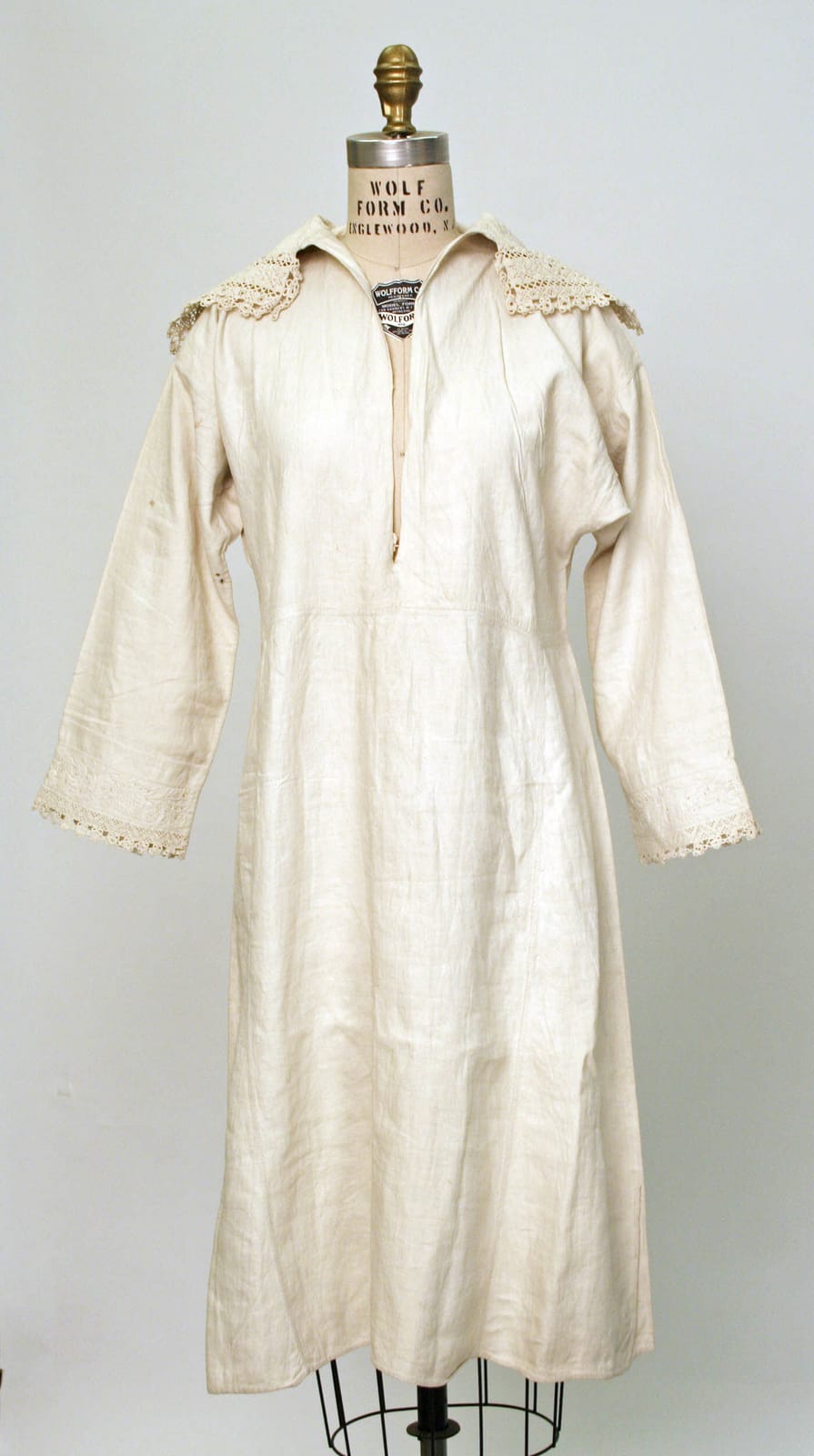
Chemise, Danish, linen, late 18th or early 19th century. The Metropolitan Museum of Art, Rogers Fund, 1923, 23.112. Wikimedia Commons, CC0.

How It Was Worn
In the decade 1400–1409, Font describes the chemise as long, reaching well below the knee, with sleeves past the elbow and a neckline, probably gathered with a drawstring, that might be low and wide.1 In the 1430s its long sleeves could show as cuffs at the wrist, and a ruffle at the hem helped support the full skirts of the dress worn over it.2
Materials and Decoration
The V&A explains that chemises were made of cotton or linen so that they could be washed easily, and that women wore them next to the skin to protect the outer layers of clothing.3 A linen chemise of 1851 in the museum's collection has a low square neck and short sleeves trimmed with a narrow linen frill, and is marked with the wearer's name and a number to identify it in the laundry.3
On This Site
- Medieval European clothing, where the chemise was the first layer
- Early modern European clothing and the chemise à la reine
- Early modern Americas clothing and the chemise dress of Creole women
Sources
- 1400–1409 — Lourdes Font, Fashion History Timeline, Fashion Institute of Technology, 2019, updated 2025 (the chemise as the foundation of women's dress, its length, sleeves, and neckline).
- 1430–1439 — Lourdes Font, Fashion History Timeline, Fashion Institute of Technology, 2021, updated 2025 (the chemise worn by all classes, its sleeves, and its hem ruffle).
- Chemise, 1851 (T.148-1961) — Victoria and Albert Museum, collection record via the museum's API (origin of the name, washable linen and cotton, and the laundry marking).