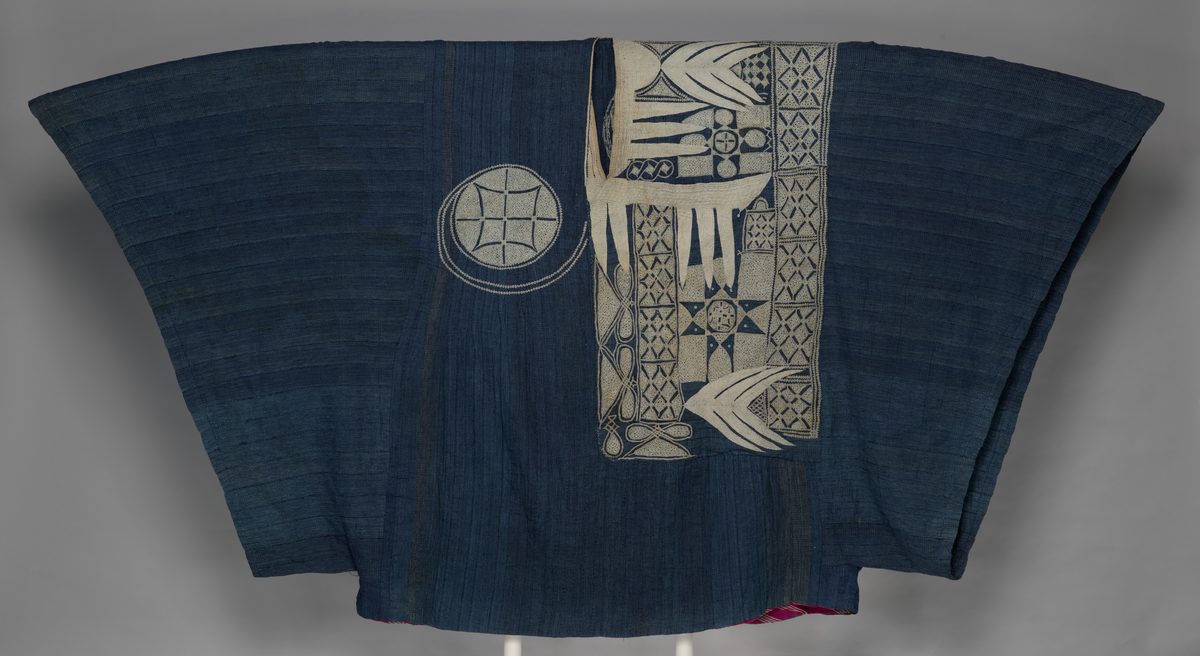
Agbada is the Yoruba name for a voluminous status robe worn by elite men in Nigeria. The Cleveland Museum of Art records the same garment type as riga in Hausa, boubou in French, and mbubb in Wolof.1 The Spencer Museum of Art calls the riga a traditional garment worn by Hausa men, worn over a tunic and trousers.2
Materials and Decoration
A Nigerian riga in Cleveland, dated late 1800s to 1910, is strip-woven cotton dyed blue by repeatedly dipping the threads in indigo before weaving; magenta silk imported by trans-Saharan routes lines the hem.1 For a 1980 babban riga made near Kano, the Spencer Museum states that Hausa men weave the cotton in wide strips on horizontal treadle looms and sew them into a large gown, and that the embroidery uses a wild silk called tsamiya, spun by women and stitched by men.2 A mid-20th-century Yoruba agbada in the Metropolitan Museum of Art is cotton, silk, and dye, given by Duro Olowu in 2014.3
Meaning and Status
The Cleveland museum states that the embroiderers were often skilled Arabic calligraphers and that the motifs once had protective Islamic symbolism; its front pocket shows the "eight knives" (aska takwas) and a leaf associated with the Nupe peoples.1 The Spencer label describes a "two knives" (aska biyu) motif, Hausa symbols blended with Qur'anic calligraphy, and a deep front pocket that can hold loose-leaf copies of the Qur'an.2
The Term Today
The Cleveland museum states that rigan historically held transcultural appeal and that today they are pan-Nigerian male national dress.1
On This Site
Sources
- Prestige robe (riga), 2013.6 — Cleveland Museum of Art, late 1800s–by 1910, Nigeria, probably Hausa-style or Nupe-style weavers and embroiderers (names in Hausa, Yoruba, French, and Wolof; indigo, silk hem, calligraphers, motifs, and national dress; record retrieved through the Cleveland open access API).
- babban riga (big gown), 2011.0231 — Spencer Museum of Art, University of Kansas, unrecorded Hausa-Fulani artist, near Kano, Nigeria, 1980; label by Nancy Mahaney, 2011 (Hausa men's garment, treadle looms, tsamiya silk, two knives motif, and the Qur'an pocket).
- Agbádá (man's ceremonial robe), 2014.751.1 — The Metropolitan Museum of Art, Yoruba, Nigeria, mid-20th century, gift of Duro Olowu, 2014 (materials and credit line; record retrieved through the Met collection API).Reference 1