Mughal Court Dress
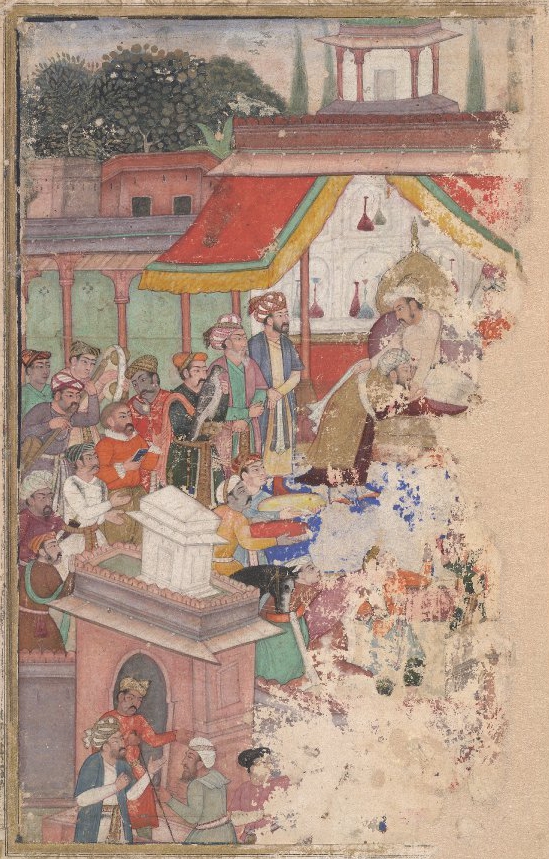
The Mughal Empire (1526–1857) fused Central Asian, Persian, and Indian clothing traditions into one of history's most opulent court wardrobes. The jama, a long crossover robe tied at the side, became the foundation of Mughal male dress, worn over tight churidar trousers that gathered in folds at the ankle. Over the jama, courtiers might add an angarkha (a chest-wrapping outer coat) or a patka (a wide sash) at the waist. The emperor's garments were distinguished by the finest fabrics — gossamer-weight muslin from Bengal, brocaded kimkhab woven with gold and silver thread, and pashmina shawls from Kashmir that could pass through a finger ring.
Women of the Mughal court wore the peshwaz, a long, flowing dress gathered below the bust, over pajama trousers, with a sheer dupatta or odhni draped over the head and shoulders. Jewelry was inseparable from dress: layered necklaces, arm bands, anklets, and forehead ornaments completed every ensemble. The Mughal passion for surface decoration gave rise to extraordinary embroidery traditions, including zardozi (gold wire embroidery), chikankari (white-on-white pulled-thread work from Lucknow), and phulkari (floral embroidery from Punjab).
Textiles and Regional Traditions
South Asia's early modern textile production was unrivaled in scale and sophistication. Dhaka muslin, woven from the finest hand-spun cotton, was so sheer that a full-length sari could be drawn through a ring — European traders called it "woven air" or "running water." The Banarasi silk industry flourished under Mughal patronage, producing brocades with intricate floral and geometric patterns in gold and silver zari thread. Meanwhile, the chintz trade — painted and printed cotton from the Coromandel Coast — conquered global markets, with Indian fabrics reaching Europe, Southeast Asia, and East Africa in enormous quantities.
Regional dress remained distinct beneath the Mughal overlay. In South India, men continued to wear the dhoti (an unstitched cloth wrapped around the lower body) and angavastram (shoulder cloth), while women draped the sari in styles that varied by community and region. Rajput courts in western India developed their own brilliant aesthetic, favoring vivid bandhani (tie-dye) turbans, fitted angarkhi tunics, and enormous pleated skirts called ghaghra for women. The interaction between Mughal courtly fashion and these regional traditions created a textile culture of extraordinary richness and variety.