During the last Ice Age, people in Europe and northern Asia wore sewn clothing of animal hide and fur, probably layered and fitted to the body, together with plant-fiber items such as string skirts, caps, and belts. No garment from this period survives, so everything we know comes from indirect evidence: bone needles, the positions of beads in graves, animal bones at campsites, impressions of woven fiber in clay, and carved figurines.3,4,1,6,7 Most of that evidence comes from the later part of the last Ice Age, the period archaeologists call the Upper Paleolithic.
The picture that emerges is far from the cartoon caveman in a single ragged pelt. Ice Age clothing was tailored, decorated, and in some cases made with considerable skill and time.
For the earlier question of when people first began wearing clothes at all, see when clothes were invented. This page picks up the story once clothing was already part of daily life.
How We Know: Evidence Without Garments
Ian Gilligan of the Australian National University6 has stressed that no actual clothing survives from the Pleistocene, the geological epoch that includes the Ice Ages.3 Clothing does not readily fossilize, and fabrics and other body coverings decay rapidly.6 Archaeologists therefore read clothing from the tools that made it and the things that were attached to it.3
Four main kinds of evidence stand out:
- Sewing tools: Bone awls and, later, eyed needles of bone, antler, and ivory show that people were piercing and joining hides.4
- Burials: Beads and pierced animal teeth found with skeletons mark where decorated garments once lay.6,9
- Animal remains: The bones of small fur-bearing animals at campsites suggest which pelts were being collected.7
- Art and impressions: Carved figurines and fiber impressions pressed into clay show caps, belts, and woven material.1,2
Each kind of evidence has limits. A needle shows sewing but not what was sewn, and a carving may show a hairstyle rather than a hat. The most reliable conclusions come where several lines of evidence agree.
Fitted Hides, Furs, and Layers
Gilligan distinguishes simple clothing, loosely draped over the body, from complex clothing, made up of assemblages of several garments. His thermal model links the need for complex clothing to the more challenging conditions of fluctuating ice age climates, which demanded more protection than loosely draped garments could give.3
The sewing tools fit this picture. A study led by Francesco d'Errico of the Universities of Bergen and Bordeaux gathered data on thousands of needles from hundreds of sites. It concluded that eyed needles were probably invented independently in China and Siberia around 42,000 years ago, and that needles were the perfect tool for making the clothing needed in the harsh environments of the Pleistocene northern hemisphere.4 In Europe, needles appear sporadically around 26,000 years ago, and their variety suggests different regional clothing traditions.4
A team at Simon Fraser University led by Mark Collard looked for a different kind of trace: the animals whose fur was used.8 Their 2016 study in the Journal of Anthropological Archaeology found remains of animals such as fox, rabbit, mink, and especially wolverine at about 56 early modern human campsites.7 Arctic peoples today still use wolverine fur to line and fringe parka hoods, and the researchers read these remains as signs of fur coats or parkas.7 Figurines from Siberia dated to about 24,000 years ago are thought to show people in furry, hooded outfits much like parkas.7,8
Beads Sewn on Clothes: The Sunghir Burials
The clearest picture of Ice Age dress comes from Sunghir, a site about 190 kilometers east of Moscow, first excavated in 1957.9 A Lomonosov Moscow State University report dates the site to between 29,000 and 31,000 years ago.10
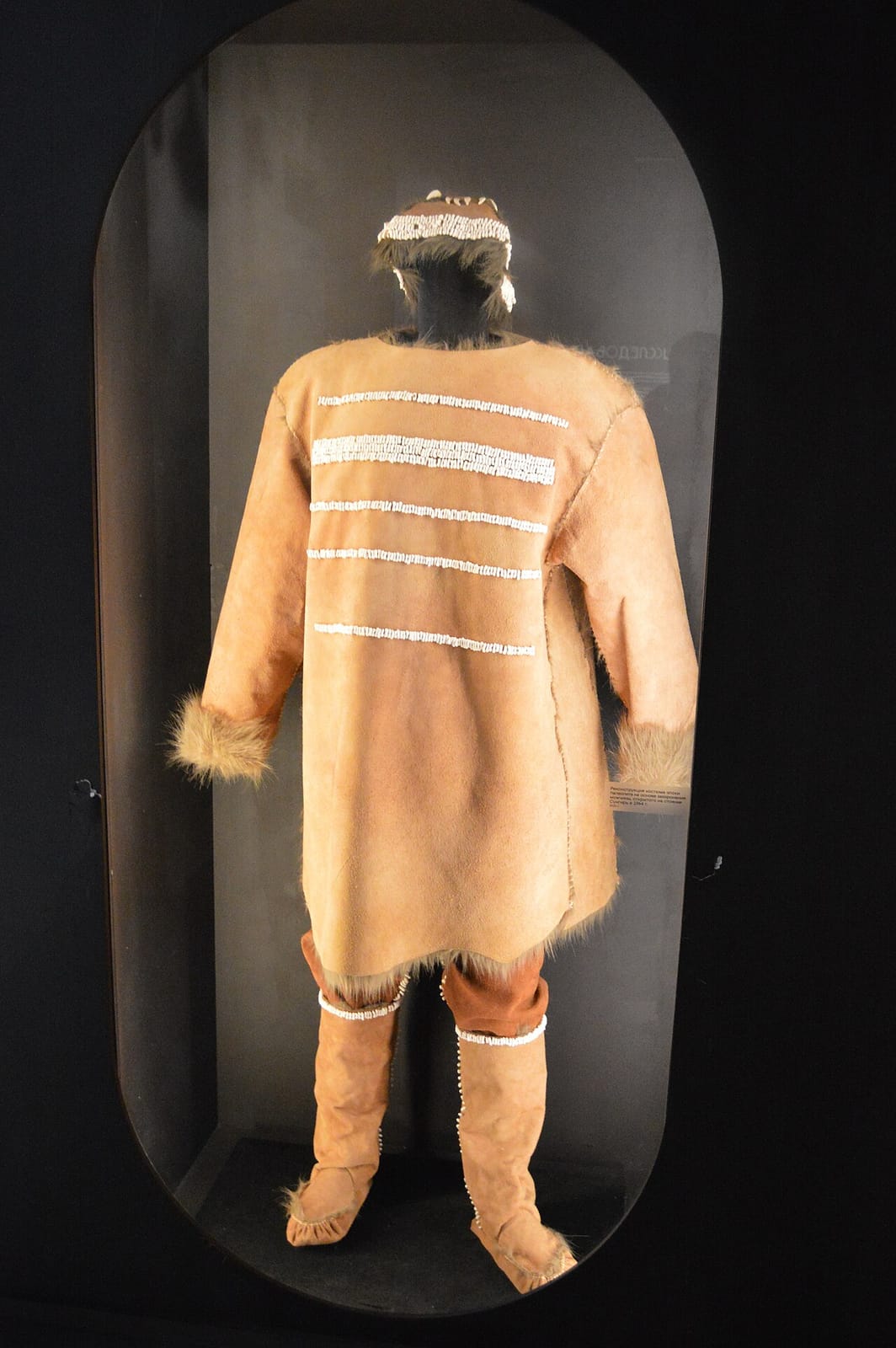

A man of about 40 was buried with some 3,000 mammoth ivory beads, 12 pierced fox canines, 25 mammoth ivory arm bands, and a stone pendant.9 Two boys of about 10 and 12, buried head to head, had more than 10,000 mammoth ivory beads and 300 pierced fox teeth between them.9 The garments themselves have decayed, but the beads and teeth that were part of them remain.6 Speaking to National Geographic in 2013, archaeologist Rebecca Wragg Sykes said that the Sunghir grave and burials like it "record the ghosts of garments" in the form of beads and teeth.6
Erik Trinkaus of Washington University in St. Louis, a co-leader of the 2018 study of the burials, suggested that the sheer number of beads means these people probably wore clothing with many beads on it all the time, not only in death.9 Work by Vladislav Zhitenev of Moscow State University supports a mix of both. Some of the fox-tooth pendants and bone beads show rubbing and wear from long use, while other ornaments appear to have been made hastily for the burial.10
Plant Fibers, Caps, and Belts
Ice Age clothing was not made only from animals. In a 2000 article, Olga Soffer of the University of Illinois, with James Adovasio and David Hyland, described 80 textile impressions on tiny clay fragments from the Czech Republic.1 Later coverage put their age at about 27,000 years.2 The impressions show plant-fiber products ranging from twined and basket-type work to plain weaves, and the finest compare with Neolithic and later cloth.1
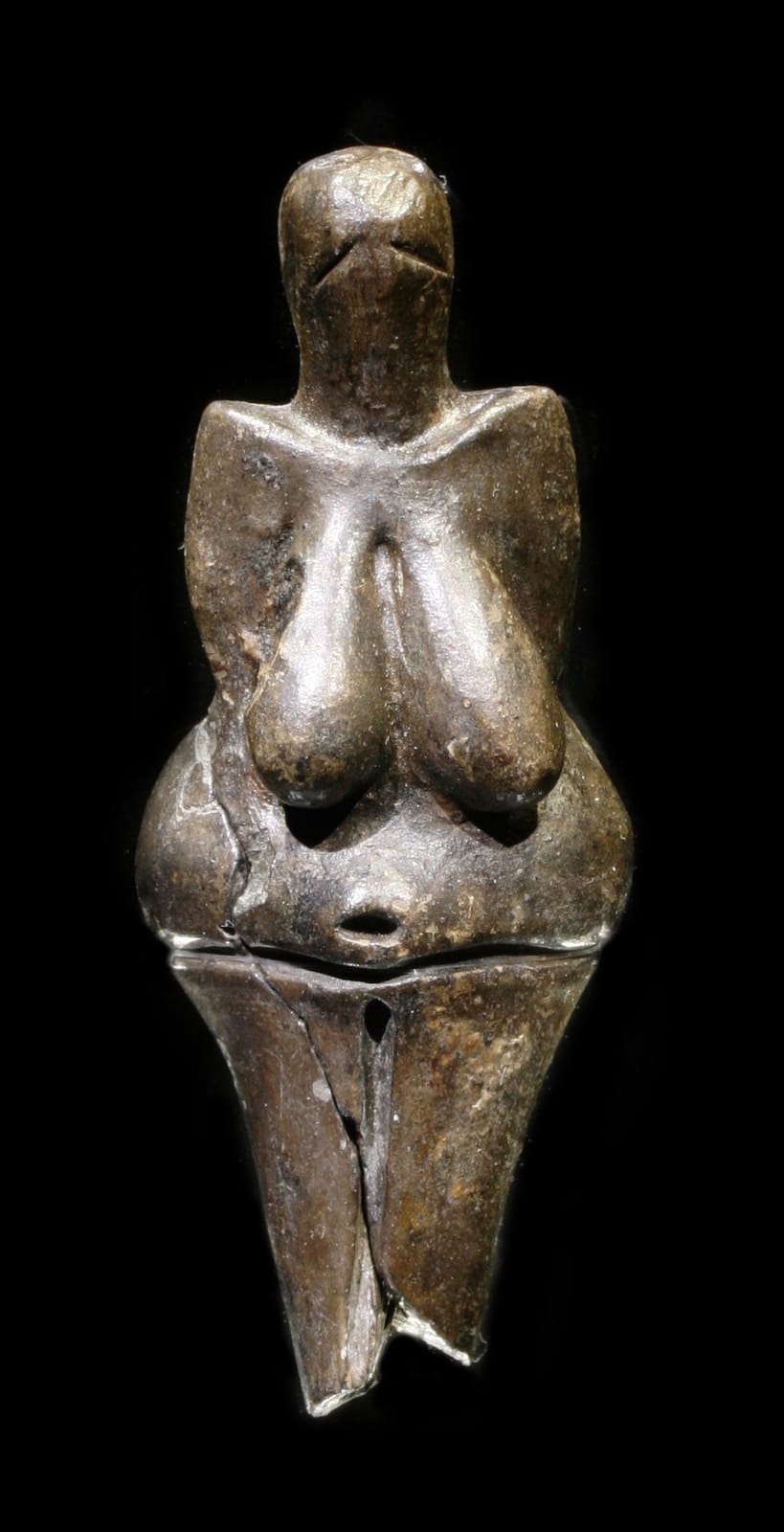

The team then compared these impressions with the clothing shown on Gravettian "Venus" figurines.1 More than 200 such figurines have been found from France to Russia, dated to about 27,000 to 20,000 years ago, and the team described about two dozen of them as clothed.2 They identified caps or snoods, belts, skirts, bandeaux (bands across the chest), bracelets, and necklaces, all made from plant fibers.1
The details varied by region. Figurines in western Europe tend to show hair nets and, in some cases, belted string skirts. Those in central and eastern Europe show coiled hats, woven upper-body bands, belts, and jewelry. Belts sit low on the hip in central and western Europe but circle the waist in eastern Europe.2 Soffer suggested that this lighter fiber clothing was probably worn in the warmer months.1
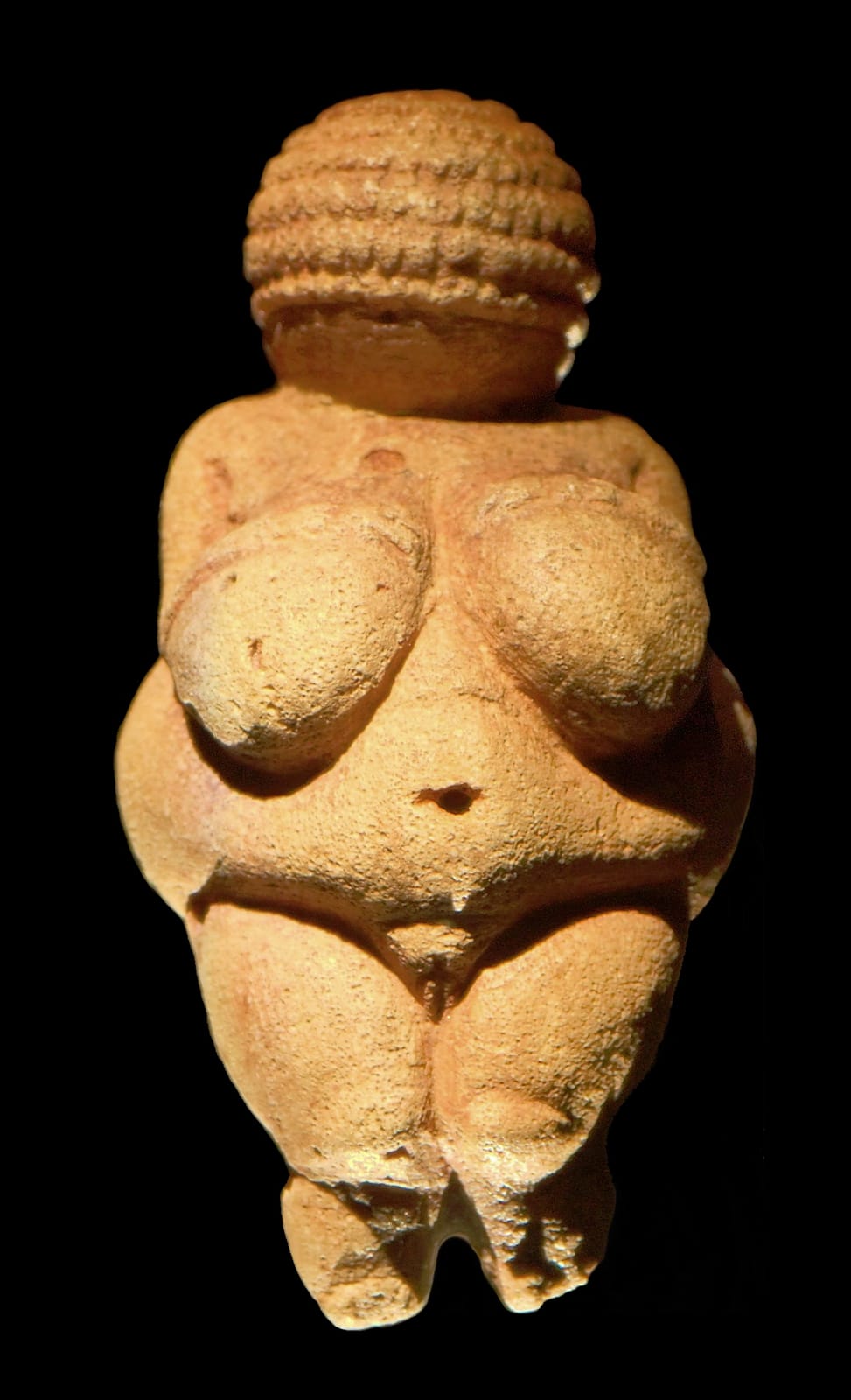

The Venus of Willendorf was found in Lower Austria in 1908 and was carved from oolite about 29,500 years ago.11 The Natural History Museum Vienna, which holds it, says only that its headdress "may indicate a hair style or cap."11 That caution applies to the whole subject.
Men, Women, and Who Made the Clothes
The evidence for men's and women's clothing is uneven. Two beaded burials at Sunghir particularly stand out: those of an adult man and two boys.9 The figurines that show caps and belts are carvings of women, so this evidence speaks mainly to women's dress.2
Soffer's team went further, proposing that women did the weaving and basketry, as they do in many traditional societies, and that women either carved the clothed figurines or guided those who did.2 They also suggested that the women who made such garments probably had high status.1 Randall White of New York University cautioned that women's roles in modern foraging groups cannot simply be assumed for the Stone Age.2 The d'Errico needle study adds that later needle uses may include embroidery, undergarments, and clothes for children, and that using needles to make tailored clothes required a long apprenticeship.4
Neanderthal and Modern Human Clothing
Neanderthals also lived through Ice Age winters in Europe. Researchers generally think they wore clothing, but the evidence suggests it was simpler. They are often thought to have worn draped animal skins, and tools for making closely fitted garments have not been found at their sites.8 The Collard team found that Neanderthal sites lacked the fur-animal remains common at early modern human camps.7
Not everyone agrees on what this difference meant. Gilligan has argued that Neanderthals' greater tolerance of cold gave them less need for elaborate clothing, while Rebecca Wragg Sykes doubts that their clothing hindered them more than it did modern humans in a changing climate.6 A 2012 survey by Nathan Wales, based on 245 recent hunter-gatherer cultures, suggested that Neanderthals in the coldest regions might have covered up to 80 percent of their bodies.6
Myths About Cavemen's Clothes
Myth: cavemen wore a single fur loincloth. The popular image of a hunter in one rough pelt has little support. Soffer argued that the fiber evidence challenges the image of hunters dressed only in fur and hide, and many of the Sunghir dead were buried wearing heavily beaded clothing.1,9 In Gilligan's model, more challenging conditions demanded more protection than loosely draped garments could give, and needles were the ideal tool for making such clothing.3,4
Myth: Ice Age clothing was purely practical. Clothing certainly kept people alive, but it also carried meaning. A 2024 paper in Science Advances by Gilligan and colleagues argued that eyed needles may mark a shift from clothing as protection to clothing as an expression of identity. In the colder parts of Eurasia late in the last Ice Age, body painting with ochre or scarification was impractical, so decoration moved onto garments, which needles allowed people to embellish with beads and other small items.5


The Venus of Lespugue from France shows how contested these readings can be. Soffer's team saw a belted string skirt worn low on the hip, while Margherita Mussi of the University of Rome argued that the "skirt" is the hair of a second, upside-down woman carved into the same figure.2
These Ice Age garments were the starting point for the longer story of prehistoric European clothing, which continued long after the ice retreated. Ötzi the Iceman, about 5,000 years old, still wore a fur jacket, leather leggings, and woven grass shoes.6
Quick Answers
What did cavemen wear?
People of the Ice Age wore sewn clothing made from animal hides and furs, probably fitted and layered, with plant-fiber items such as caps, belts, and string skirts. Many garments were decorated with beads and pierced animal teeth.1,3,9
Did Ice Age people have sewing needles?
Yes. Eyed needles were probably invented in China and Siberia around 42,000 years ago, and they appear in Europe around 26,000 years ago. Before that, bone awls were used to pierce hides.4
What animals did Ice Age people use for clothes?
Remains at early modern human campsites in Europe point to fox, rabbit, mink, and especially wolverine, whose fur is still prized for parka hoods.7 Mammoth ivory was carved into beads to decorate garments.9
Did Ice Age people wear woven cloth?
Some did. Impressions in clay from the Czech Republic, about 27,000 years old, show plant-fiber cordage, basketry, and woven material.1,2
Sources
- Ice Age Clothing Said To Be More Advanced Than Previously Thought — ScienceDaily, from University of Illinois at Urbana-Champaign materials, 3 February 2000 (Soffer, Adovasio, and Hyland; clay textile impressions; figurine caps, belts, skirts, and bandeaux).
- Stone Age statuettes don disputed apparel — Bruce Bower, Science News, 21 October 2000 (regional figurine clothing, Lespugue, critiques, and claims about women's weaving).
- The prehistoric development of clothing: Archaeological implications of a thermal model — Ian Gilligan, Journal of Archaeological Method and Theory 17 (2010): 15–80, abstract via Australian National University research portal (simple and complex clothing; no surviving Pleistocene garments).
- UiB researcher sheds new light on the origin of sewing technologies — University of Bergen (SapienCE), 2018 (d'Errico needle study, dates and regions, uses of needles).
- The beginnings of fashion — University of Sydney, 29 June 2024 (Gilligan and colleagues, "Paleolithic eyed needles and the evolution of dress," Science Advances).
- As Fashion Week Ends, Pondering the Origins of Clothes — Riley Black, National Geographic, 11 September 2013 (Sunghir "ghosts of garments," Neanderthal clothing debate, Wales study).
- Neanderthals' failure to make parkas may have sealed their demise — Bob Yirka, Phys.org, 4 August 2016 (Collard et al., Journal of Anthropological Archaeology; wolverine and other fur animals).
- Warm Coats May Have Given Modern Humans an Ice-Age Edge — Archaeology Magazine, 1 August 2016 (Neanderthal draped skins; Siberian figurines in hooded outfits).
- Sunghir burial of two children, report — Tibi Puiu, ZME Science, 15 February 2018 (Sunghir location, grave goods, and Trinkaus on beaded clothing).
- Adornments told about the culture of prehistoric people — Popular Archaeology, reporting research by Vladislav Zhitenev, Lomonosov Moscow State University (Sungir dating and worn versus burial ornaments).
- Venus of Willendorf — Natural History Museum Vienna, Google Arts & Culture exhibit (age, material, discovery, and headdress).