Ottoman Dress and Textile Arts
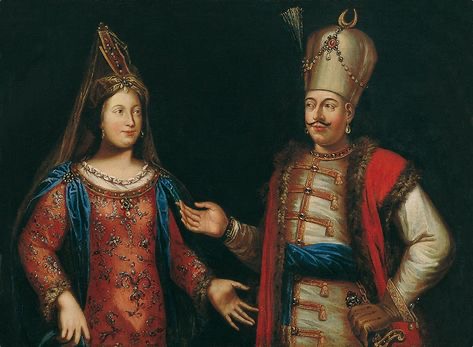
The Ottoman Empire (1299–1922) elevated the kaftan to the supreme expression of imperial authority. Court kaftans were tailored from the finest silks — including kemha (a heavy brocade), seraser (cloth of gold and silver), and çatma (cut velvet) — and featured bold, large-scale patterns of tulips, carnations, pomegranates, and arabesques. The sultan's wardrobe was vast and ceremonial: he might wear a different kaftan each day, and hundreds were stored in the Topkapi Palace treasury, where many survive today as some of the best-preserved garments of the early modern world.
Beneath the kaftan, Ottoman men wore a gömlek (linen shirt), şalvar (wide trousers), and a fitted entari (inner robe), with the whole ensemble crowned by a turban wrapped around a tall felt cap. The size, shape, and fabric of the turban indicated rank and profession with exacting precision. Women's dress in the Ottoman world consisted of similar layered garments — chemise, trousers, inner and outer robes — often made from diaphanous silks and embellished with gold embroidery. Outdoors, women covered themselves with a large enveloping cloak called a ferace and a face veil or yaşmak.
Safavid Persia and the Wider Islamic World
The Safavid dynasty (1501–1736) made Persia a rival to Ottoman Turkey in textile splendor. Shah Abbas I established royal silk workshops in Isfahan that produced extraordinary figured silks featuring courtly scenes, hunters on horseback, and portraits — a striking departure from the geometric and floral patterns preferred by the Ottomans. The Safavid court favored a more fitted silhouette than the Ottomans, with a shorter qaba (robe) that fell to the knee, wrapped and tied with a kamarband sash, and worn over slim trousers. The distinctive Safavid taj — a tall, baton-shaped turban with a protruding rod — became a political symbol of the Shia dynasty.
Across the broader Islamic world, dress reflected both shared principles and local adaptation. In North Africa, the burnous (a hooded cloak) and haik (a large draped cloth) remained staples of daily dress, while the cities of Fez and Tunis developed their own luxury textile traditions. In Yemen and the Arabian Peninsula, indigo-dyed cotton from India was prized, and the khanjar (curved dagger) worn at the belt served as both weapon and status marker. Trade connected these diverse regions: Ottoman silks traveled south into Africa, Safavid velvets moved east to Mughal India, and Indian cotton flowed everywhere, creating a vast shared material culture across the Islamic world.