North American Dress: Frontier to Factory
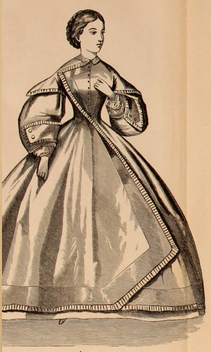
Early 19th-century American clothing largely followed European fashions, imported or copied from pattern books and fashion plates. But the realities of frontier life demanded practical adaptations. On the expanding western frontier, men wore buckskin jackets and trousers influenced by Indigenous garment traditions, sturdy denim work clothes, and wide-brimmed hats for sun protection. The California Gold Rush of 1849 helped popularize rugged work wear — Levi Strauss and Jacob Davis patented their riveted blue jeans in 1873, creating what would become America's most iconic garment.
For the urban middle class, the century brought a revolution in how clothing was obtained. The rise of department stores — Macy's in New York, Marshall Field's in Chicago, Wanamaker's in Philadelphia — made fashionable ready-to-wear clothing accessible to a broad public. The sewing machine, patented by Isaac Singer in the 1850s, transformed both home sewing and industrial garment production. By century's end, American women could order the latest styles from mail-order catalogs like Sears, Roebuck and Co., bringing fashion to even the most remote communities.
Latin American National Dress and Cultural Fusion
Across Latin America, the 19th century was an era of independence movements and nation-building, and clothing played a role in defining new national identities. In Mexico, the china poblana ensemble — a richly embroidered blouse with a sequined skirt — became a symbol of Mexican womanhood, blending Indigenous, Spanish, and possibly Asian textile traditions. Mexican charros developed their distinctive horseman's outfit with fitted trousers, short jacket, and wide-brimmed sombrero, a style that became an enduring national icon.
In the Andean regions, Indigenous communities maintained traditional dress including the poncho for men and the layered skirts and manta shawls for women, often incorporating vibrant colors from natural dyes and later aniline dyes imported from Europe. In Argentina, the gaucho of the Pampas wore baggy bombachas trousers, leather boots, and a broad belt adorned with silver coins. Brazilian dress reflected the country's complex social hierarchy — elite women followed Parisian fashion closely, while Afro-Brazilian communities in Bahia developed the distinctive baiana dress with its turbaned headwrap, full white skirts, and layered pano da costa shawl, rooted in West African textile traditions.